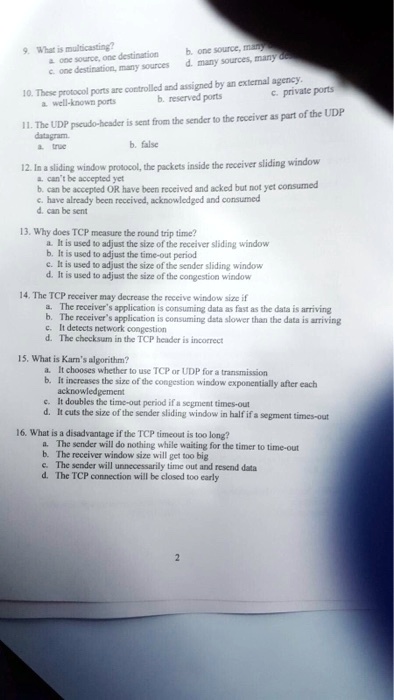
9. What is multicasting?
a. one source, one destination
c. one destination, many sources
10. These protocol ports are controlled and assigned by an external agency.
a. well-known ports
b. reserved ports
c. private ports
11. The UDP pseudo-header is sent from the sender to the receiver as part of the UDP
datagram.
a. true
b. false
12. In a sliding window protocol, the packets inside the receiver sliding window
a. can't be accepted yet
b. can be accepted OR have been received and acked but not yet consumed
c. have already been received, acknowledged and consumed
d. can be sent
13. Why does TCP measure the round trip time?
a. It is used to adjust the size of the receiver sliding window
b. It is used to adjust the time-out period
c. It is used to adjust the size of the sender sliding window
d. It is used to adjust the size of the congestion window
14. The TCP receiver may decrease the receive window size if
a. The receiver's application is consuming data as fast as the data is arriving
b. The receiver's application is consuming data slower than the data is arriving
c. It detects network congestion
d. The checksum in the TCP header is incorrect
15. What is Karn's algorithm?
a. It chooses whether to use TCP or UDP for a transmission
b. It increases the size of the congestion window exponentially after each
acknowledgement
c. It doubles the time-out period if a segment times-out
d. It cuts the size of the sender sliding window in half if a segment times-out
16. What is a disadvantage if the TCP timeout is too long?
a. The sender will do nothing while waiting for the timer to time-out
b. The receiver window size will get too big
c. The sender will unnecessarily time out and resend data
d. The TCP connection will be closed too early
2
b. one source, many
d. many sources, many de