Ace - AI Tutor
Ask Our Educators
Textbooks
My Library
Flashcards
Scribe - AI Notes
Notes & Exams
Download App
carla brown

carla b.

Divider

Questions asked

BEST MATCH

Page 2 of 4 2. Calculate the surface area of the curve below, over the x-interval 1≤ x ≤2, revolved about the y-axis. (8 pt) $$y = \frac{x^4}{8} + \frac{1}{4x^2}$$

View Answer
divider
BEST MATCH

QUESTION 6 Consider the poset $(A, R)$ represented by the following Hasse diagram. b c d e f h g (a) Give each of the following. If it (they) does (do) not exist, explain clearly why. (i) The greatest element of $(A, R)$. (ii) The least element of $(A, R)$. (iii) All upper bounds of $\{e, f\}$. (iv) The least upper bound (LUB) of $\{e, f\}$. (v) All lower bounds of $\{b, d\}$. (vi) The greatest lower bound (GLB) of $\{b, d\}$. (vii) A complement of $b$. (viii) A complement of $f$. (b) Give complete reasons for answers to the following. (i) Is $(A, R)$ a lattice? (ii) Is $(A, R)$ a complemented lattice? (iii) Is $(A, R)$ a Boolean algebra?

View Answer
divider
BEST MATCH

Sunny Apparel has the following accounts at December 31: Common Stock, $1 par value, 1,900,000 shares issued; Additional Paid-in Capital, $16.10 million; Retained Earnings, $9.10 million; and Treasury Stock, 41,000 shares, $0.902 million. Prepare the stockholders' equity section of the balance sheet. (Amounts to be deducted should be indicated by a minus sign. Enter your answer in dollars, not millions. For example, $5.5 million should be entered as 5,500,000) SUNNY APPAREL Balance Sheet (Stockholders' Equity Section) December 31 Stockholders' equity: Common Stock Additional Paid-in Capital Total paid-in capital Retained Earnings Treasury Stock Total stockholders' equity $ 1,900,000 1,900,000 $ 1,900,000

View Answer
divider
BEST MATCH

Click the icon to view the table. Determine the null and alternative hypotheses. Choose the correct answer below. A. H_(0) : The distribution of hockey players' birth months is uniformly distributed. H_(1) : More hockey players are born in the first half of the year than the second half. B. H_(0) : The distribution of hockey players' birth months is uniformly distributed. H_(1) : The distribution of hockey players' birth months is not uniformly distributed. C. H_(0) : The distribution of hockey players' birth months is not uniformly distributed. H_(1) : The distribution of hockey players' birth months is uniformly distributed. D. H_(0) : The distribution of hockey players' birth months is uniformly distributed. H_(1) : More hockey players are born in January-March than October-December. Compute the expected counts for each birth month. The total number of hockey players is 164. (Round to two decimal places as needed.) able[[Birth Month,Observed Count,Expected Count],[January-March,53,â—» Click the icon to view the table. Determine the null and alternative hypotheses. Choose the correct answer below: A. H0: The distribution of hockey players' birth months is uniformly distributed. H1: More hockey players are born in the first half of the year than the second half. B. H0: The distribution of hockey players' birth months is uniformly distributed. H1: The distribution of hockey players' birth months is not uniformly distributed. C. H0: The distribution of hockey players' birth months is not uniformly distributed. H1: The distribution of hockey players' birth months is uniformly distributed. D. H0: The distribution of hockey players' birth months is uniformly distributed. H1: More hockey players are born in January-March than October-December. Compute the expected counts for each birth month. The total number of hockey players is 164. (Round to two decimal places as needed.) Birth Month Observed Count Expected Count January-March 53 April-June 53 July-September 26 October-December 32

View Answer
divider
BEST MATCH

Articulated by his book published in 1936, the theory that government can use the budget to steer the economy can be attributed to _____ Oa. Paul Volcker Ob. V. O. Key Oc. Aaron Wildavsky Od. John Maynard Keynes

View Answer
divider
BEST MATCH

Which behavioral paradigm was used by Barrett & Smith (2005) to demonstrate the opponent process involved in the development of anxiety in rats as a conditioned compensatory response to tranquilizer? (A) Progressive ratio schedule of reinforcement (B) Dissociation (C) Drug Discrimination (D) Conditioned Place Preference

View Answer
divider
BEST MATCH

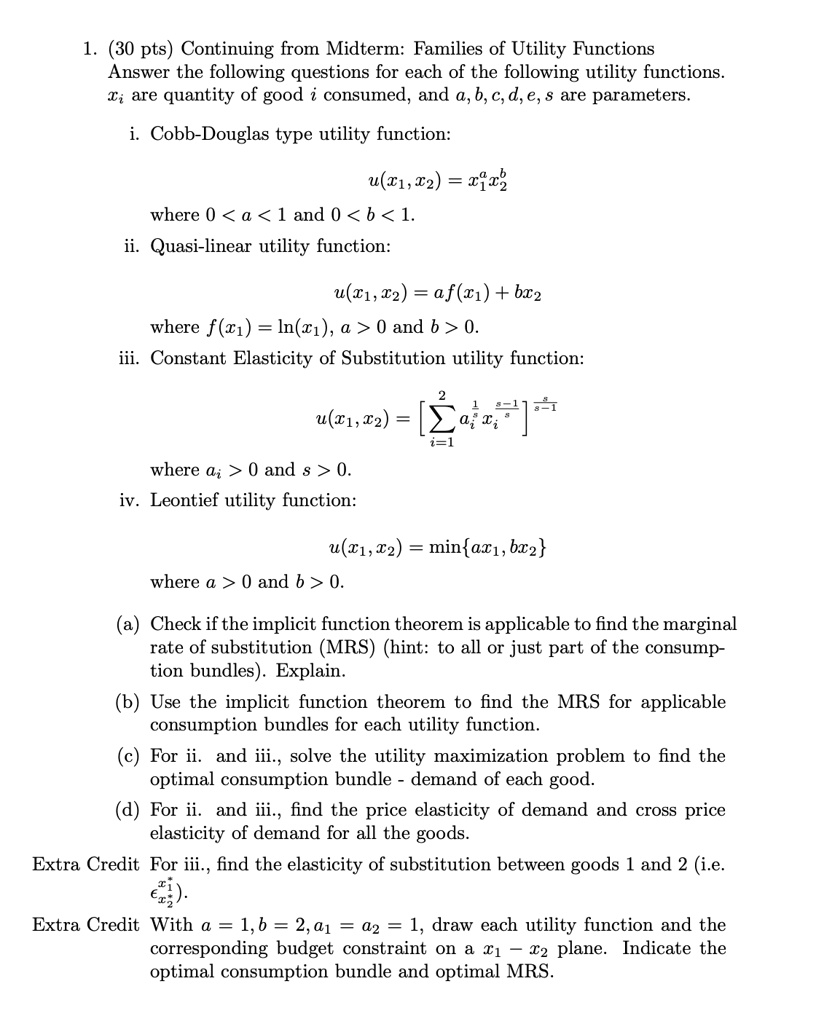
Please answer parts a,b,c,d only for the Leontief utility function and show all work!!(30 pts) Continuing from Midterm: Families of Utility Functions Answer the following questions for each of the following utility functions. x_(i) are quantity of good i consumed, and a,b,c,d,e,s are parameters. i. Cobb-Douglas type utility function: u(x_(1),x_(2))=x_(1)^(a)x_(2)^(b) where u(x_(1),x_(2))=af(x_(1))+bx_(2)f(x_(1))=ln(x_(1)),a>0b>0u(x_(1),x_(2))=[sum_(i=1)^2 a_(i)^((1)/(s))x_(i)^((s-1)/(s))]^((s)/(s-1))a_(i)>0s>0u(x_(1),x_(2))=min{ax_(1),bx_(2)}a>0b>0{:epsi lon_(x_(2)^(**))^(x_(1)^(**)))a=1,b=2,a_(1)=a_(2)=1x_(1)-x_(2) 1. (30 pts) Continuing from Midterm: Families of Utility Functions Answer the following questions for each of the following utility functions. T; are quantity of good i consumed, and a, b, c, d, e, s are parameters. i. Cobb-Douglas type utility function: u(x1,x2)=xxb where0<a<1 and0<b<1 ti. Quasi-linear utility function: u(x1,x2)=af(x1)+bx2 where fx)=ln),a>0 and b>0 iii. Constant Elasticity of Substitution utility function: 1s1s aixis where a; > 0 and s > 0. iv. Leontief utility function: u(x1,x2)=min{ax1,bx2} where a > 0 and b>0 (a) Check if the implicit function theorem is applicable to find the marginal rate of substitution (MRS) (hint: to all or just part of the consump tion bundles). Explain. (b) Use the implicit function theorem to find the MRS for applicable consumption bundles for each utility function. (c) For ii. and iii., solve the utility maximization problem to find the optimal consumption bundle - demand of each good. (d) For ii. and iii., find the price elasticity of demand and cross price elasticity of demand for all the goods. Extra Credit For iii., find the elasticity of substitution between goods 1 and 2 (i.e ). Extra Credit With a = 1,b = 2,a1 = a2 = 1, draw each utility function and the corresponding budget constraint on a - 2 plane. Indicate the optimal consumption bundle and optimal MRS.
View Answer
divider
BEST MATCH

A tall glass beaker is filled with a layer of water 17.0 cm deep, and floating on top of the water, a layer of oil 34.0 cm thick. The oil has a specific gravity of 0.600. What is the absolute pressure (in Pa) at the bottom of the beaker? (Assume the atmospheric pressure is $1.013 \times 10^5$ Pa. Round your answer to at least three significant figures.) What is the definition of specific gravity? From atmospheric pressure and the density of the oil, what is the absolute pressure at the bottom of the oil layer? From this pressure, and the density of the water, what is the pressure at the bottom of the water layer? Be careful with unit conversions. Pa

View Answer
divider
BEST MATCH

Given the following two functions: g(x)=\sin x \cos x GRAPH on [?2?,2?] × [?2, 2], \frac{x^3}{x^2-4} GRAPH on [-10, 10] × [-12, 12], graph each function, its first and second derivatives, on the same coordinate plane. Highlight the function (in yellow), the first derivative (in green) and the second derivative (in blue). Then for each function, use information from the function itself, its first and second derivatives to answer the questions below about the function in the given table below. Write NA (not applicable) where appropriate. Attach all two sets of three graphs to your lab. Be sure to show all work for full credit! 1. g(x)=\sin x \cos x all answers on [-2?, 2?] Function Domain Function Range (hint: use g'(x)) x- Intercept(s) Horizontal Asymptote Slant Asymptote g'(x) = y- intercept Vertical Asymptote(s) Critical Numbers(s)

View Answer
divider
BEST MATCH

The purpose of this challenge is to use arrays and functions. This challenge calculates the day of the year given the nth day of the year. Requirements: Write a function string get_date(int day) that will return a string indicating the month and day of the year based on an integer input. For this function to return a string that is a combination of a month (a string) and a day (an integer), you will have to use the to_string() function. string get_date(int day) { // month will represent an index into the months array // day_of_month will represent the resulting day // within the calculated month int day_of_month, month; // more code here // to use to_string(), see the compiler requirements below // to_string() is a library function // you do not need to create it return months[month] + " " + to_string(day_of_month); } In the function, declare a string array as below: string months[12] = { "Jan", "Feb", "Mar", "Apr", "May", "Jun", "Jul", "Aug", "Sep", "Oct", "Nov", "Dec" }; In the function, declare an int array as below: int days[12] = {31, 28, 31, 30, 31, 30, 31, 31, 30, 31, 30, 31}; In main, ask the user to enter an integer between 1 and 365. Display to the user the month and day by calling the get_date() function. (See interaction) Compiler Requirements: When compiling your code having used the to_string() function, you may have to compile as below (don't type the dollar sign): $ g++ -std=c++11 yourfile.cpp Hints: Your get_date() function can be written - at minimum - with two accumulators, a while loop, and a subtraction or two. DO NOT USE any built-in date/time functions. Sample Interaction / Output: Enter the nth day of the year: 5 Day 5 is Jan 5 [run it again] Enter the nth day of the year: 59 Day 59 is Feb 28 [run it again] Enter the nth day of the year: 365 Day 365 is Dec 31

View Answer
divider