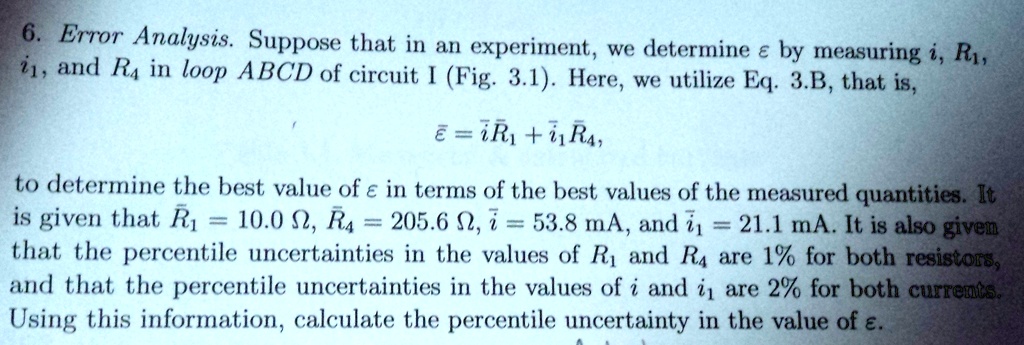
6. Error Analysis. Suppose that in an experiment, we determine ? by measuring i, R1, i1, and R4 in loop ABCD of circuit I (Fig. 3.1). Here, we utilize Eq. 3.B, that is,
\(\varepsilon = \bar{i}\bar{R}_1 + \bar{i}_1\bar{R}_4,\)
to determine the best value of ? in terms of the best values of the measured quantities. It is given that \(\bar{R}_1 = 10.0 \Omega\), \(\bar{R}_4 = 205.6 \Omega\), \(\bar{i} = 53.8 \text{ mA}\), and \(\bar{i}_1 = 21.1 \text{ mA}\). It is also given that the percentile uncertainties in the values of R1 and R4 are 1% for both resistors, and that the percentile uncertainties in the values of i and i1 are 2% for both currents. Using this information, calculate the percentile uncertainty in the value of ?.