Ace - AI Tutor
Ask Our Educators
Textbooks
My Library
Flashcards
Scribe - AI Notes
Notes & Exams
Download App
carla king

carla k.

Divider

Questions asked

BEST MATCH

You place a crate of mass 32.8 kg on a frictionless 4.55-meter-long incline. You release the crate from rest, and it begins to slide down, eventually reaching the bottom 2.17 s after you released it. What is the angle of the incline?

View Answer
divider
BEST MATCH

11. A 100 kg car accelerates uniformly from rest for a distance of 20 min 10 s. What is the car's momentum at time t = 5 s?

View Answer
divider
BEST MATCH

The more inelastic the demand and the more inelastic the supply, the smaller the consumer surplus is relative to the producer surplus.

View Answer
divider
BEST MATCH

In this relationship we find one organism is gaining no benefit but is also not being harmed while the other gains direct benefit.

View Answer
divider
BEST MATCH

A consumer's preferences for goods X and Y are given by U(X, Y) = X^0.6Y^0.4. The price of X is $10, and the price of Y is $20. The consumer has an income of $5000. a. What is the utility-maximizing choice of X and Y? b. How would the utility-maximizing choice change if the price of Y increased to $50? c. Given the answers to the previous parts, plot a linear approximation to the demand function for Y.

View Answer
divider
BEST MATCH

Evaluate the following. Given F=ma, find the value of m, when a=9 and F=72

View Answer
divider
BEST MATCH

Texts: Ms. Lover Foolish is the CEO of a company producing a new magical supplement "Love is Strange". A marketing campaign promised an increase in intimacy as you use this new supplement. Ms. Foolish conducted a study to estimate the demand for "Love is Strange" and found the following: Let P(X) = price of Love is Strange; P(y) = the price of a cream: "Life is fun"; M = income, A = Advertising expense; Q = quantity demanded of "Love is Strange" P(x) P(y) M A Q 56.41 43.22 42.68 61.31 63.26 21.82 68.46 14.32 55.06 65.42 26.42 39.79 51.23 14.78 37.78 64.16 66.32 10.92 62.99 14.22 73.83 45.76 20.11 42.62 69.26 15.52 81.06 37.15 85.34 46.81 19.98 10.19 36.86 74.63 53.94 81.21 77.42 20.86 12.35 53.17 73.82 35.68 25.01 89.25 34.79 76.06 32.56 24.67 47.00 57.05 75.72 66.92 31.95 50.43 8.49 31.55 69.17 51.32 64.44 7.54 29.54 9.34 19.46 2.00 1 1- Assuming that the demand is not linear, use a log-linear estimation to find the log-linear demand function. 2- Is the cream "Life is fun" a substitute or a complementary good? Why? 3- Ms. Foolish claimed that the demand function should be linear. Use a linear estimation method to find the linear demand function. Would your findings support a linear function? Why? 4- Using the linear demand function you derived in part 3, if P(x) = 50, P(y) = 15, M = 1200, A = 518, find the cross-price elasticity E[Q(X), P(Y)].

View Answer
divider
BEST MATCH

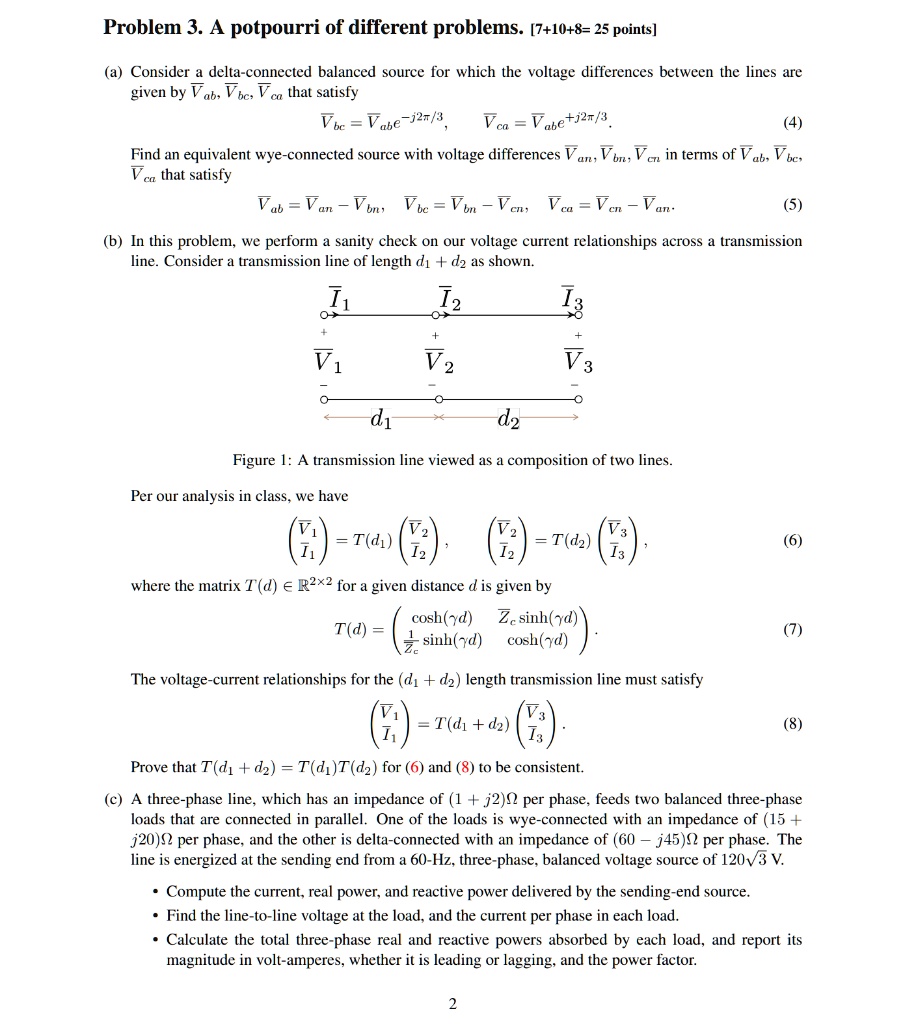
Problem 3: A Potpourri of Different Problems (a) Consider a delta-connected balanced source for which the voltage differences between the lines are given by Vab, Vbc, Vca that satisfy Vbc = Vab - j2n/3 and Vca = Vab + j2n/3. Find an equivalent wye-connected source with voltage differences Van, Von, Ven in terms of Vab, Voe, and Vea that satisfy Vab = Van - Von, Vbc = Von - Vcn, and Vca = Vcn - Van. (b) In this problem, we perform a sanity check on our voltage-current relationships across a transmission line. Consider a transmission line of length d1 + d2 as shown in Figure 1. Per our analysis in class, we have where the matrix T(d) is a 2x2 matrix for a given distance d and is given by cosh(d) Z sinh(d) cosh(d) The voltage-current relationships for the (d1 + d2) length transmission line must satisfy Prove that T(d + d) = T(d)T(d) for (6) and (8) to be consistent. A three-phase line, which has an impedance of (1 + j2) per phase, feeds two balanced three-phase loads that are connected in parallel. One of the loads is wye-connected with an impedance of (15 + j20) per phase, and the other is delta-connected with an impedance of (60 - j45) per phase. The line is energized at the sending end from a 60-Hz, three-phase, balanced voltage source of 120/√3 V. Compute the current, real power, and reactive power delivered by the sending-end source. Find the line-to-line voltage at the load and the current per phase in each load. Calculate the total three-phase real and reactive powers absorbed by each load and report its magnitude in volt-amperes, whether it is leading or lagging, and the power factor.
View Answer
divider
BEST MATCH

8. A mixture consists of 60 g of ice and 40 g of liquid water, both at 0°C. The amount of heat that must be added to melt all of the ice is about ($L_f$=80 cal/g) Show calculation: () 3200 cal () 4000 cal () 4800 cal () 8000 cal 9. An ice cube of mass 100 g and at 0°C is dropped into a Styrofoam cup containing 200 g of water at 25°C. Calculate how much heat is available by cooling the water to 0°C and how much heat is required to melt the ice. Available Heat: $Q_{available}$=____ cal. $L_f$=80 cal/g; $c_w$ = 1.0 cal/g °C Required heat: $Q_{required}$=____ cal Will all the ice melt?_____ Show calculation:

View Answer
divider
BEST MATCH

1. a) Consider the vectors \(\vec{u} = (-7, 4, -1)\) and \(\vec{v} = (8, 0, -6)\) calculate \(4\vec{u} - \frac{3}{2}\vec{v}\). [2] b) Express the result from a) in unit vector from (linear combination of \(\vec{i}\), \(\vec{j}\), and \(\vec{k}\)) [2] c) Determine the exact value of \(|\vec{u} + \vec{v}|\). [2] 2. If \(|\vec{a}| = 5\), \(|\vec{b}| = 8\) and the angle between the two vectors is 120°, determine the unit vector in the same direction as \(2\vec{a} - 3\vec{b}\). State the direction as an angle in relation to \(\vec{a}\). [4]

View Answer
divider