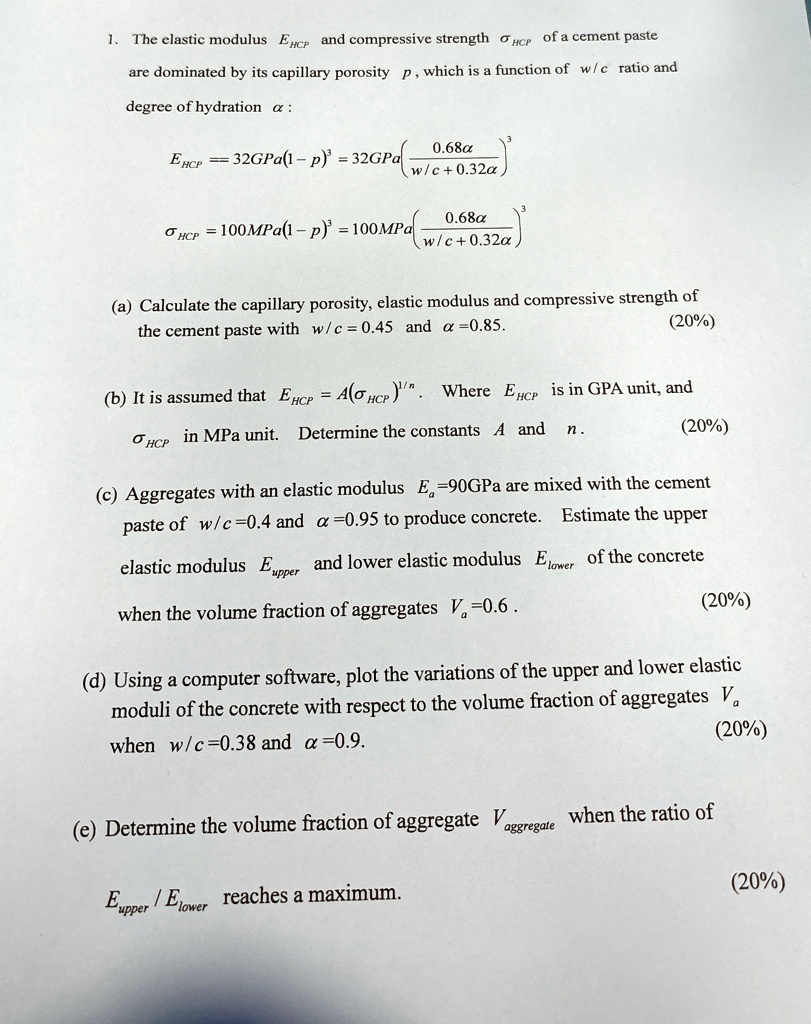
1. The elastic modulus $E_{HCP}$ and compressive strength $\sigma_{HCP}$ of a cement paste
are dominated by its capillary porosity $p$, which is a function of $w/c$ ratio and
degree of hydration $\alpha$:
$E_{HCP} = 32GPa(1-p)^3 = 32GPa(\frac{0.68\alpha}{w/c + 0.32\alpha})^3$
$\sigma_{HCP} = 100MPa(1-p)^3 = 100MPa(\frac{0.68\alpha}{w/c + 0.32\alpha})^3$
(a) Calculate the capillary porosity, elastic modulus and compressive strength of
the cement paste with $w/c = 0.45$ and $\alpha = 0.85$. (20%)
(b) It is assumed that $E_{HCP} = A(\sigma_{HCP})^n$. Where $E_{HCP}$ is in GPA unit, and
$\sigma_{HCP}$ in MPa unit. Determine the constants $A$ and $n$. (20%)
(c) Aggregates with an elastic modulus $E_a = 90GPa$ are mixed with the cement
paste of $w/c = 0.4$ and $\alpha = 0.95$ to produce concrete. Estimate the upper
elastic modulus $E_{upper}$ and lower elastic modulus $E_{lower}$ of the concrete
when the volume fraction of aggregates $V_a = 0.6$. (20%)
(d) Using a computer software, plot the variations of the upper and lower elastic
moduli of the concrete with respect to the volume fraction of aggregates $V_a$
when $w/c = 0.38$ and $\alpha = 0.9$. (20%)
(e) Determine the volume fraction of aggregate $V_{aggregate}$ when the ratio of
$E_{upper}/E_{lower}$ reaches a maximum. (20%)