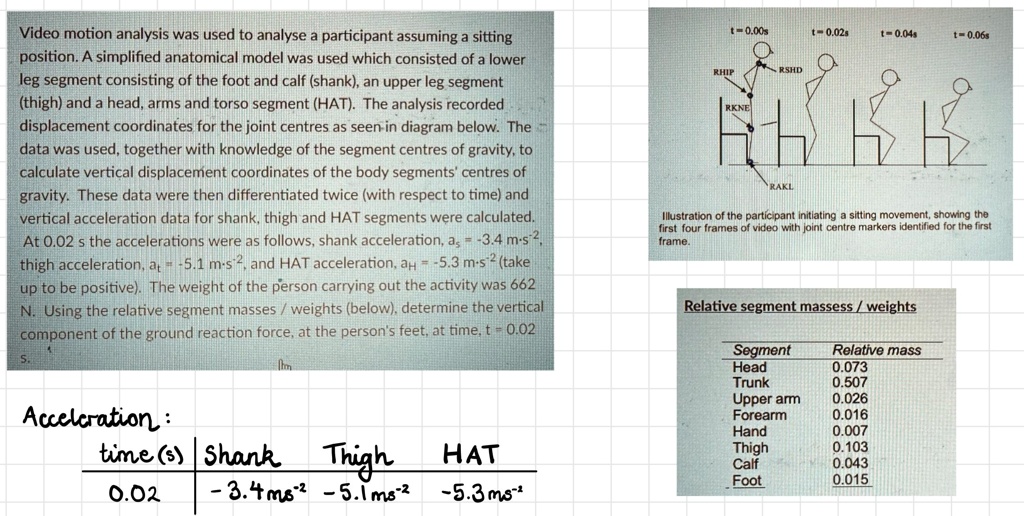
Video motion analysis was used to analyze a participant assuming a sitting position. A simplified anatomical model was used which consisted of a lower leg segment consisting of the foot and calf (shank), an upper leg segment (thigh), and a head, arms, and torso segment (HAT). The analysis recorded displacement coordinates for the joint centers as seen in the diagram below. The data was used, together with knowledge of the segment centers of gravity, to calculate vertical displacement coordinates of the body segments' centers of gravity. These data were then differentiated twice (with respect to time) and vertical acceleration data for shank, thigh, and HAT segments were calculated. At 0.02s the accelerations were as follows: shank acceleration, a_(s) = -3.4 m/s^(-2), thigh acceleration, a_(t) = -5.1 m/s^(-2), and HAT acceleration, a_(H) = -5.3 m/s^(-2) (take up to be positive). The weight of the person carrying out the activity was 662 N. Using the relative segment masses/weights (below), determine the vertical component of the ground reaction force, at the person's feet, at time, t = 0.02 s.
Illustration of the participant initiating a sitting movement, showing the first four frames of video with joint center markers identified for the first frame.
Relative segment masses/weights
Segment Head Trunk Upper arm Forearm Hand Thigh Calf Foot
Relative mass 0.073 0.507 0.026 0.016 0.007 0.103 0.043 0.015
Acceleration: time(s) Shank Thigh HAT 0.02 - 3.4 m/s^2 -5.1 m/s^2 -5.3 m/s^2