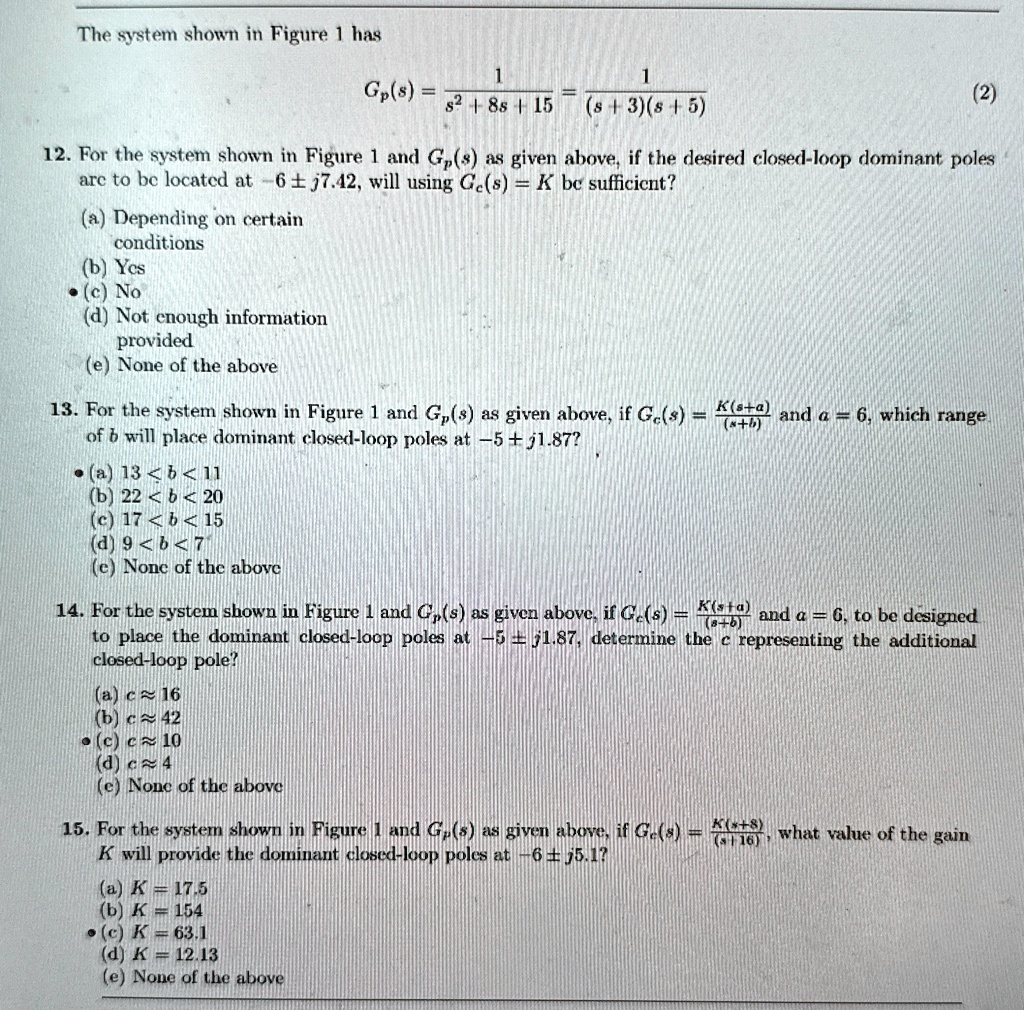
The system shown in Figure 1 has
$$G_p(s) = \frac{1}{s^2 + 8s + 15} = \frac{1}{(s+3)(s+5)}$$
12. For the system shown in Figure 1 and $G_p(s)$ as given above, if the desired closed-loop dominant poles are to be located at $-6 \pm j7.42$, will using $G_c(s) = K$ be sufficient?
(a) Depending on certain conditions
(b) Yes
(c) No
(d) Not enough information provided
(e) None of the above
13. For the system shown in Figure 1 and $G_p(s)$ as given above, if $G_c(s) = \frac{K(s+a)}{(s+b)}$ and $a = 6$, which range of $b$ will place dominant closed-loop poles at $-5 \pm j1.87$?
(a) $13 < b < 11$
(b) $22 < b < 20$
(c) $17 < b < 15$
(d) $9 < b < 7$
(e) None of the above
14. For the system shown in Figure 1 and $G_p(s)$ as given above, if $G_c(s) = \frac{K(s+a)}{(s+b)(s+c)}$ and $a = 6$, to be designed to place the dominant closed-loop poles at $-5 \pm j1.87$, determine the $c$ representing the additional closed-loop pole?
(a) $c \approx 16$
(b) $c \approx 42$
(c) $c \approx 10$
(d) $c \approx 4$
(e) None of the above
15. For the system shown in Figure 1 and $G_p(s)$ as given above, if $G_c(s) = \frac{K(s+8)}{(s+16)}$, what value of the gain $K$ will provide the dominant closed-loop poles at $-6 \pm j5.1$?
(a) $K = 17.5$
(b) $K = 154$
(c) $K = 63.1$
(d) $K = 12.13$
(e) None of the above