Questions asked
The beam is subjected to the load at its end. Take $P = 4.0 \text{ kN}$ and $V = 2.0 \text{ kN}$. (Figure 1) Figure Part A Determine the maximum principal stress at point $B$. Express your answer to three significant figures and include the appropriate units. $\sigma = $ Value Units Submit Request Answer Provide Feedback
Which of the formulas must be molecular formulas? $\square$ C$_{5}$H$_{9}$ $\square$ PO $\square$ C$_{4}$H$_{5}$N$_{2}$O $\square$ C$_{2}$H$_{4}$O$_{2}$ $\square$ H$_{2}$O$_{2}$
Determine how many grams of N2 are producted from the reaction of 8.92 g of H2O2 and 5.53 g of N2H4
Identify the required (JK) F/F input conditions for the state transitions presented in the table below and synthesise the sequential circuit specified by the table. Present Input Next state Flip flop inputs Output state B A X B A JB KB JA KA Y 0 0 0 1 0 0 0 0 1 1 0 0 0 1 0 0 0 0 1 1 1 1 0 1 0 0 0 1 1 1 0 1 0 1 1 1 1 0 0 0 0 1 1 1 0 0 0
Initial rate data for the reaction Q + R --> 2T is provided below: [Q], M 0.010 0.020 0.020 [R], M Rate, Ms-1 0.020 125 0.020 500 0.040 500 What is the rate law for this reaction? Rate = k[Q][R] Rate = k[Q]$^2$[R] Rate = k[2Q] Rate = k[Q]$^2$
5. Suppose a particle moves along a curve $y = f(x)$ in the $xy$-plane such that at each point $(x, y)$ of the curve, the tangent line has gradient $x \ln(1 + x)$. Determine the equation of the curve given that it passes through the point $(0, 1)$.
Problem 1 (Short Answer) Answer the following questions in 2-4 sentences: a. Explain why and how velocity and thermal boundary layers form. b. Describe how the temperature gradient in the boundary layer affects the convection coefficient. c. Explain what the \"film temperature\" is and why it is important in convection problems. d. Compare turbulent boundary layers and boundary layer separation in terms of their effects on convection heat transfer.
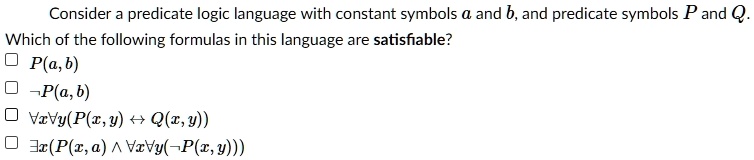
Consider a predicate logic language with constant symbols a and b, and predicate symbols P and Q. Which of the following formulas in this language are satisfiable? ? P(a, b) ? ¬P(a, b) ? ?x?y(P(x, y) ? Q(x, y)) ? ?x(P(x, a) ? ?x?y(¬P(x, y)))
The ______ are a mixed group of substances, including lysergic acid diethylamide (LSD) and peyote. Multiple Choice benzodiazepines amphetamines hallucinogens opioids
38. Shown below is a DNA coding strand: 5'T-A-C-T-T-C-C-C-G-A-T-C-A-T-T-3'. a). Using the genetic code table provided, list the amino acid sequence at the end of translation. Show how you arrive at your answer). /content/enforced/132881-30929.202230/GENETIC CODE TABLE new.docx