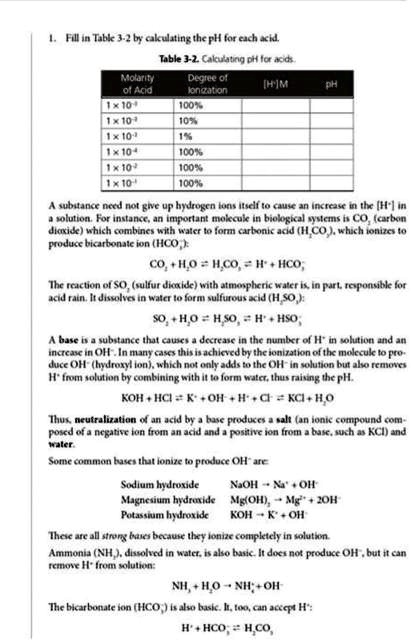
Texts: 1. Fill in Table 3-2 by calculating the pH for each acid.
Table 3-2: Calculating pH for acids
Degree of Acid [H+]M pH
1x10 100% 10
10% 10
1% 10
100% 110
100% 10
100%
A substance need not give up hydrogen ions itself to cause an increase in the [H+] in a solution. For instance, an important molecule in biological systems is CO2, carbon dioxide, which combines with water to form carbonic acid (H2CO3), which ionizes to produce bicarbonate ion (HCO3-).
CO2 + H2O = H2CO3 = H+ + HCO3-
The reaction of SO2, sulfur dioxide, with atmospheric water is, in part, responsible for acid rain. It dissolves in water to form sulfurous acid (HSO3-).
SO2 + H2O = HSO3- + H+
A base is a substance that causes a decrease in the number of H+ in solution and an increase in OH-. In many cases, this is achieved by the ionization of the molecule to produce OH- (hydroxyl ion), which not only adds to the OH- in solution but also removes H+ from solution by combining with it to form water, thus raising the pH.
KOH + HCl = K+ + OH- + H+ + Cl- = KCl + H2O
Thus, neutralization of an acid by a base produces a salt, an ionic compound composed of a negative ion from an acid and a positive ion from a base, such as KCl, and water.
Some common bases that ionize to produce OH- are:
Sodium hydroxide (NaOH): Na+ + OH-
Magnesium hydroxide (Mg(OH)2): Mg2+ + 2OH-
Potassium hydroxide (KOH): K+ + OH-
These are all strong bases because they ionize completely in solution. Ammonia (NH3) dissolved in water is also basic. It does not produce OH-, but it can remove H+ from solution:
NH3 + H2O = NH4+ + OH-
The bicarbonate ion (HCO3-) is also basic. It too can accept H+:
H+ + HCO3- = H2CO3