Texts: Can you please answer question c) and d) please. A and B are easy.
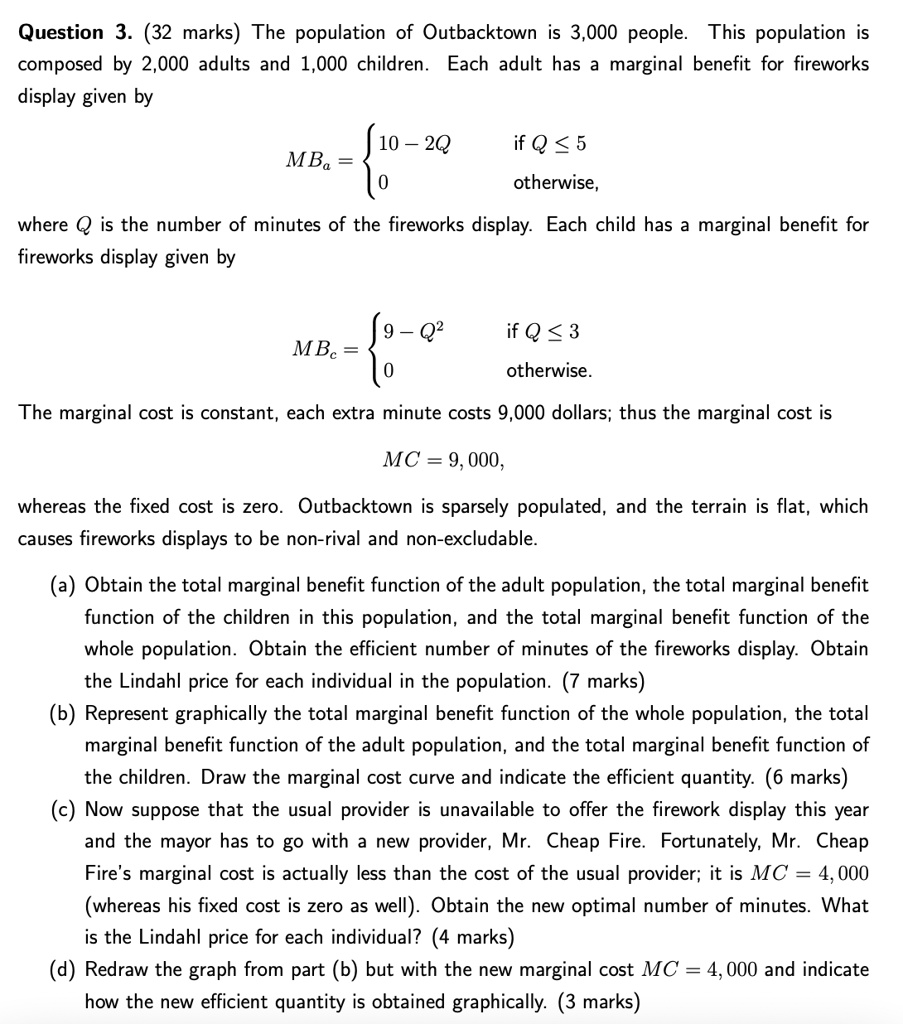
Question 3. (32 marks) The population of Outbacktown is 3,000 people. This population is composed of 2,000 adults and 1,000 children. Each adult has a marginal benefit for a fireworks display given by
10-2Q
if Q < 5
MBa =
otherwise,
where Q is the number of minutes of the fireworks display. Each child has a marginal benefit for a fireworks display given by
if Q < 3
MBc =
otherwise.
The marginal cost is constant, each extra minute costs 9,000 dollars; thus the marginal cost is
MC = 9,000,
whereas the fixed cost is zero. Outbacktown is sparsely populated, and the terrain is flat, which causes fireworks displays to be non-rival and non-excludable.
(a) Obtain the total marginal benefit function of the adult population, the total marginal benefit function of the children in this population, and the total marginal benefit function of the whole population. Obtain the efficient number of minutes of the fireworks display. Obtain the Lindahl price for each individual in the population. (7 marks)
(b) Represent graphically the total marginal benefit function of the whole population, the total marginal benefit function of the adult population, and the total marginal benefit function of the children. Draw the marginal cost curve and indicate the efficient quantity. (6 marks)
(c) Now suppose that the usual provider is unavailable to offer the firework display this year and the mayor has to go with a new provider, Mr. Cheap Fire. Fortunately, Mr. Cheap Fire's marginal cost is actually less than the cost of the usual provider; it is MC = 4,000 (whereas his fixed cost is zero as well). Obtain the new optimal number of minutes. What is the Lindahl price for each individual? (4 marks)
(d) Redraw the graph from part (b) but with the new marginal cost MC = 4,000 and indicate how the new efficient quantity is obtained graphically. (3 marks)