Exercise 4.5.1
Use the first derivative test to locate all local extrema for $f(x) = -x^3 + \frac{3}{2}x^2 + 18x$.
Step 1. The derivative is $f'(x) = -3x^2 + 3x + 18$ and this factors as $f'(x) = -3(x^2 - x - 6) = -3(x + 2)(x - 3)$, so the critical points are $x = -2$ and $x = 3$, which divide $(-\infty, \infty)$ into the smaller intervals $(-\infty, -2)$, $(-2, 3)$ and $(3, \infty)$.
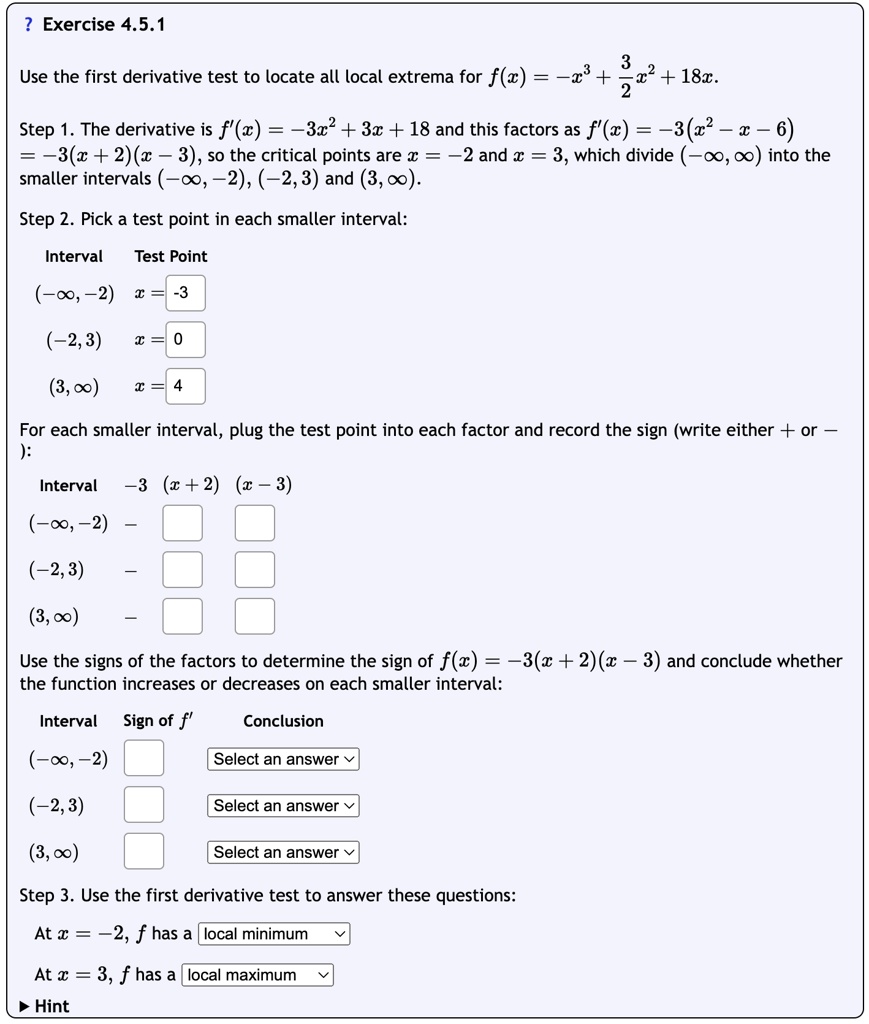
Step 2. Pick a test point in each smaller interval:
Interval Test Point
$(-\infty, -2)$ $x = -3$
$(-2, 3)$ $x = 0$
$(3, \infty)$ $x = 4$
For each smaller interval, plug the test point into each factor and record the sign (write either + or -):
Interval $-3$ $(x + 2)$ $(x - 3)$
$(-\infty, -2)$
$(-2, 3)$
$(3, \infty)$
Use the signs of the factors to determine the sign of $f'(x) = -3(x + 2)(x - 3)$ and conclude whether the function increases or decreases on each smaller interval:
Interval Sign of $f'$ Conclusion
$(-\infty, -2)$
$(-2, 3)$
$(3, \infty)$
Step 3. Use the first derivative test to answer these questions:
At $x = -2$, $f$ has a local minimum
At $x = 3$, $f$ has a local maximum
Hint