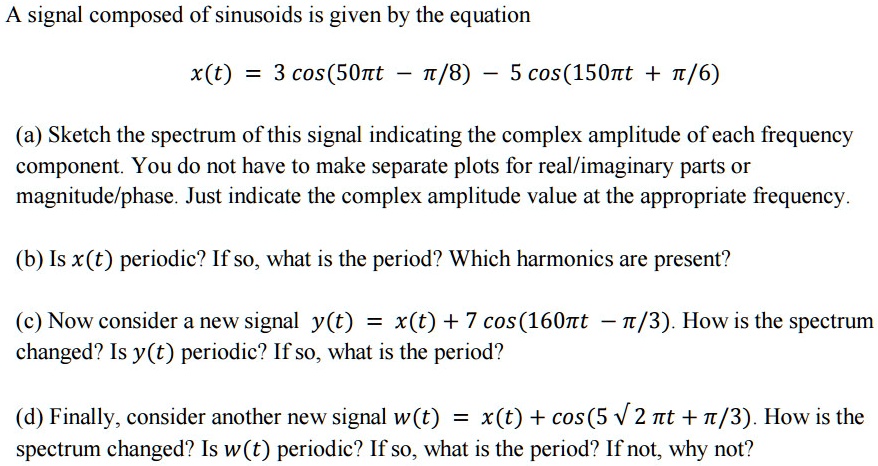
A signal composed of sinusoids is given by the equation
x(t) = 3 cos(50?t – ?/8) – 5 cos(150?t + ?/6)
(a) Sketch the spectrum of this signal indicating the complex amplitude of each frequency
component. You do not have to make separate plots for real/imaginary parts or
magnitude/phase. Just indicate the complex amplitude value at the appropriate frequency.
(b) Is x(t) periodic? If so, what is the period? Which harmonics are present?
(c) Now consider a new signal y(t) = x(t) + 7 cos(160?t – ?/3). How is the spectrum
changed? Is y(t) periodic? If so, what is the period?
(d) Finally, consider another new signal w(t) = x(t) + cos(5 \sqrt{2} ?t + ?/3). How is the
spectrum changed? Is w(t) periodic? If so, what is the period? If not, why not?