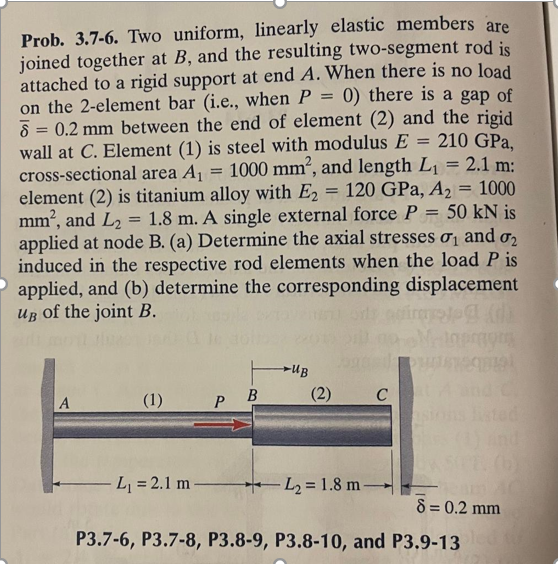
Prob. 3.7-6. Two uniform, linearly elastic members are joined together at \( B \), and the resulting two-segment rod is attached to a rigid support at end \( A \). When there is no load on the 2-element bar (i.e., when \( P=0 \) ) there is a gap of \( \bar{\delta}=0.2 \mathrm{~mm} \) between the end of element (2) and the rigid wall at \( C \). Element (1) is steel with modulus \( E=210 \mathrm{GPa} \), cross-sectional area \( A_{1}=1000 \mathrm{~mm}^{2} \), and length \( L_{1}=2.1 \mathrm{~m} \) : element (2) is titanium alloy with \( E_{2}=120 \mathrm{GPa}, A_{2}=1000 \) \( \mathrm{mm}^{2} \), and \( L_{2}=1.8 \mathrm{~m} \). A single external force \( P=50 \mathrm{kN} \) is applied at node B. (a) Determine the axial stresses \( \sigma_{1} \) and \( \sigma_{2} \) induced in the respective rod elements when the load \( P \) is applied, and (b) determine the corresponding displacement \( u_{B} \) of the joint \( B \).
P3.7-6, P3.7-8, P3.8-9, P3.8-10, and P3.9-13