Ace - AI Tutor
Ask Our Educators
Textbooks
My Library
Flashcards
Scribe - AI Notes
Notes & Exams
Download App
carolina vergara

carolina v.

Divider

Questions asked

BEST MATCH

When thorium (A = 90) emits a beta particle, the resulting nucleus has atomic number Group of answer choices 90. [none of these] 89. 92. 88.

View Answer
divider
BEST MATCH

you design a collar strategy by buying a put and writing a call on the same underlying stock. both options are American style

View Answer
divider
BEST MATCH

Consider the balanced chemical reaction below: \[ 3 \mathrm{Na}_{2} \mathrm{CrO}_{4}(a q)+\mathrm{Ni}_{2}\left(\mathrm{SO}_{3}\right)_{3}(a q) \rightarrow 3 \mathrm{Na}_{2} \mathrm{SO}_{3}(a q)+\mathrm{Ni}_{2}\left(\mathrm{CrO}_{4}\right)_{3}(s) \] When 14.50 g of \( \mathrm{Na}_{2} \mathrm{CrO}_{4} \) is mixed with 17.25 g of \( \mathrm{Ni}_{2}\left(\mathrm{SO}_{3}\right)_{3}, 10.368 \mathrm{~g} \) of \( \mathrm{Ni}_{2}\left(\mathrm{CrO}_{4}\right)_{3} \) is obtainec What reactant is the limiting reactant? What is the percent yield? \( \mathrm{Na}_{2} \mathrm{CrO}_{4} \) is the limiting reactant. The percent yield is 24.9\% \( \mathrm{Ni}_{2}\left(\mathrm{SO}_{3}\right)_{3} \) is the limiting reactant. The percent yield is 46.2\%. \( \mathrm{Ni}_{2}\left(\mathrm{SO}_{3}\right)_{3} \) is the limiting reactant. The percent yield is 60.1\% \( \mathrm{Na}_{2} \mathrm{CrO}_{4} \) is the limiting reactant. The percent yield is 25.3\%. \( \mathrm{Na}_{2} \mathrm{CrO}_{4} \) is the limiting reactant. The percent yield is 74.7\%. \begin{tabular}{||l|l|} \hline \multicolumn{1}{|c|}{ Compound } & \multicolumn{1}{c|}{\begin{tabular}{c} Molar Mass \\ (g/mol) \end{tabular}} \\ \hline \( \mathrm{Na}_{2} \mathrm{CrO}_{4} \) & 161.9732 \\ \hline \( \mathrm{Ni}_{2}\left(\mathrm{SO}_{3}\right)_{3} \) & 357.5606 \\ \hline \( \mathrm{Na}_{2} \mathrm{SO}_{3} \) & 126.0378 \\ \hline \( \mathrm{Ni}_{2}\left(\mathrm{CrO}_{4}\right)_{3} \) & 465.3668 \\ \hline \end{tabular} Submit Question

View Answer
divider
BEST MATCH

Twentieth century music and art seemed to be a form of regurgitation of much of the art of the Romantic and Classical eras, just with a slight twist. True False

View Answer
divider
BEST MATCH

Given the system: $-x_1 - x_2 + 5x_3 = 3$ $-x_1 + 4x_2 - x_3 = 2$ $8x_1 - x_2 - x_3 = 6$ Rearrange the system (if possible, to grantee the convergence), and then use Gauss Seidel method to obtain an approximate solution.

View Answer
divider
BEST MATCH

Marisol is a psychologist who conducts research on the sexual response cycle. To best familiarize herself with the research that has already been done on this area, Marisol should read the writings of Marisol is a psychologist who conducts research on the sexual response cycle. To best familiarize herself with the research that has already been done on this area, Marisol should read the writings of Sigmund Freud. William Masters and Virginia Johnson. Alfred Kinsey and his colleagues. Simon LeVay.

View Answer
divider
BEST MATCH

Qulz 1, Chapters 5.6 6 Totral utlily is moximized when the \( \operatorname{oog}_{2 \pi: 30} \) Multiple cho/ce Price is less than the margingol untity Drice is equo/ to the morgingl wility marginal utility is zero. morgmal unlly is moximizeded

View Answer
divider
BEST MATCH

IV. Prove 2 of the following 3 theorems. (10 points each) 1. Let $(G, \cdot)$ be a group and let $S \subset G$ be nonempty. Suppose that the following hold. i. S is closed with respect to multiplication. ii. If $a \in S$, then $a^{-1} \in S$. Then S is a subgroup of G. 2. Suppose an element $a$ in a group has order $n$. Then $a^t = e$ if and only if $t$ is a multiple of $n$. 3. A ring has the cancellation property if and only if it has no divisors of zero.

View Answer
divider
BEST MATCH

The H NMR spectrum of p-methoxyacetophenone has signals whose chemical shifts are indicated below. Which hydrogen or set of hydrogens corresponds to the signal at 6.9 ppm? Select the single best answer. H H H$_3$C-C || O CH$_3$ O A H H B C p-methoxyacetophenone $^1$H NMR: 2.5 ppm, 3.9 ppm, 6.9 ppm, 7.9 ppm A B C D X S
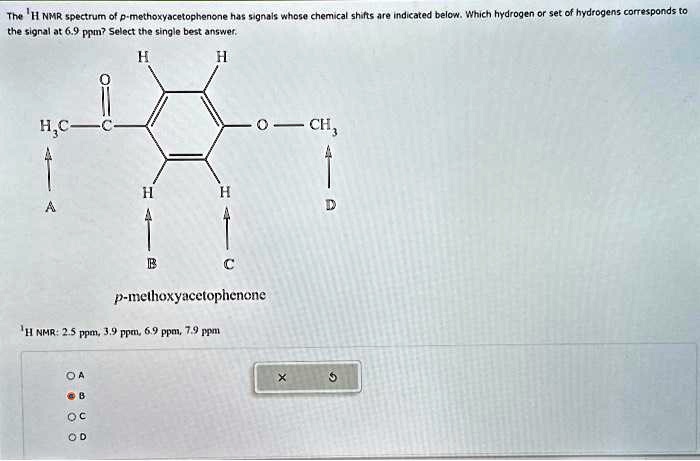
View Answer
divider
BEST MATCH

Consider two masses $m_1$ and $m_2$ connected by a thin string. Assume the following values: $m_1 = 3.7 \text{ kg}$ and $m_2 = 1.0 \text{ kg}$. Ignore friction and the mass of the string. Part A - Find the acceleration of the two masses. $a = 1.256 \frac{m}{s^2}$ Part B - Changing the value of mass $m_1$ while keeping mass $m_2$ constant would change the acceleration of the two-mass system. What should be the value of mass $m_1$ to get the largest possible value of acceleration of the two masses? $m_1 = 0$

View Answer
divider