Ace - AI Tutor
Ask Our Educators
Textbooks
My Library
Flashcards
Scribe - AI Notes
Notes & Exams
Download App
carolyn hobbs

carolyn h.

Divider

Questions asked

BEST MATCH

Bohr's shift refers to Bohr's shift refers to The bending of the hemoglobin molecule that occurs at elevated temperatures The lack of oxygen when we exercise A change in hemoglobin affinity for oxygen due to lower blood pH A mutation in the hemoglobin gene in certain human populations

View Answer
divider
BEST MATCH

An illustration of the relationship between tax rates and tax revenues is called the loanable funds market. aggregate demand-aggregate supply model. Laffer curve. marginal tax curve.

View Answer
divider
BEST MATCH

What do research studies show about the benefits or problems with going to college?

View Answer
divider
BEST MATCH

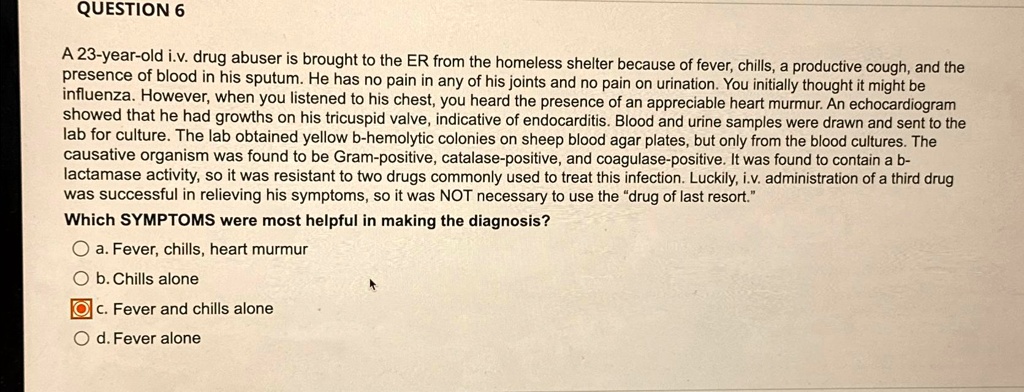
QUESTION 6 A 23-year-old i.v. drug abuser is brought to the ER from the homeless shelter because of fever, chills, a productive cough, and the presence of blood in his sputum. He has no pain in any of his joints and no pain on urination. You initially thought it might be influenza. However, when you listened to his chest, you heard the presence of an appreciable heart murmur. An echocardiogram showed that he had growths on his tricuspid valve, indicative of endocarditis. Blood and urine samples were drawn and sent to the lab for culture. The lab obtained yellow b-hemolytic colonies on sheep blood agar plates, but only from the blood cultures. The causative organism was found to be Gram-positive, catalase-positive, and coagulase-positive. It was found to contain a blactamase activity, so it was resistant to two drugs commonly used to treat this infection. Luckily, i.v. administration of a third drug was successful in relieving his symptoms, so it was NOT necessary to use the "drug of last resort." Which SYMPTOMS were most helpful in making the diagnosis? a. Fever, chills, heart murmur b. Chills alone c. Fever and chills alone d. Fever alone QUESTION6 A 23-year-old i.v. drug abuser is brought to the ER from the homeless shelter because of fever, chills, a productive cough, and the presence of blood in his sputum. He has no pain in any of his joints and no pain on urination. You initially thought it might be influenza. However, when you listened to his chest, you heard the presence of an appreciable heart murmur. An echocardiogram showed that he had growths on his tricuspid valve, indicative of endocarditis. Blood and urine samples were drawn and sent to the lab for culture. The lab obtained yellow b-hemolytic colonies on sheep blood agar plates, but only from the blood cultures. The causative organism was found to be Gram-positive, catalase-positive, and coagulase-positive. It was found to contain a b- lactamase activity, so it was resistant to two drugs commonly used to treat this infection. Luckily, i.v. administration of a third drug was successful in relieving his symptoms, so it was NOT necessary to use the "drug of last resort. Which SYMPTOMS were most helpful in making the diagnosis? O a.Fever,chills,heart murmur Ob.Chills alone Oc.Fever and chills alone O d.Fever alone
View Answer
divider
BEST MATCH

Match each type of allergic reaction (hypersensitivity) with its corresponding characteristics. Type I [ Choose ] Mediated by T cells Mediated by IgM and IgD Mediated by IgE and mast cell activation Caused by parasitic infections Can lead to hemolytic anemia (decrease in red blood cells) and thrombocytopenia (decrease in platelets) Small aggregates of IgG antibody bound to intradermal antigen leads to Fc receptor activation Type II [ Choose ] Mediated by T cells Mediated by IgM and IgD Mediated by IgE and mast cell activation Caused by parasitic infections Can lead to hemolytic anemia (decrease in red blood cells) and thrombocytopenia (decrease in platelets) Small aggregates of IgG antibody bound to intradermal antigen leads to Fc receptor activation Type III [ Choose ] Mediated by T cells Mediated by IgM and IgD Mediated by IgE and mast cell activation Caused by parasitic infections Can lead to hemolytic anemia (decrease in red blood cells) and thrombocytopenia (decrease in platelets) Small aggregates of IgG antibody bound to intradermal antigen leads to Fc receptor activation Type IV [ Choose ] Mediated by T cells Mediated by IgM and IgD Mediated by IgE and mast cell activation Caused by parasitic infections Can lead to hemolytic anemia (decrease in red blood cells) and thrombocytopenia (decrease in platelets) Small aggregates of IgG antibody bound to intradermal antigen leads to Fc receptor activation

View Answer
divider
BEST MATCH

Find the most general antiderivative of the function. (Che f(x) = \frac{1}{2}x^2 - 2x + 8 F(x) = \frac{x^3}{5} - x^2 + 8x + C

View Answer
divider
BEST MATCH

15. In monopolistic competition, (a) there is no entry and exit. (b) each firm produces slightly differentiated product. (c) each firm is a price taker. (d) there are few firms in the market. (e) each firm observes a horizontal demand curve.

View Answer
divider
BEST MATCH

Find the inverse of the given matrix, if it exists. $M = \begin{bmatrix} 2 & -7 \\ 7 & -24 \end{bmatrix}$

View Answer
divider
BEST MATCH

Given CT signal, x(t) and h(t), find y(t)=x(t)*h(t). Sketch x(t) and h(t). Determine and sketch all regions of the convolution. x(t)=u(t+4)-u(t-1). h(t)=sin(?t)u(t).

View Answer
divider
BEST MATCH

(17%) Problem 3: Consider an object moving in a circular orbit around a planet, due to the force of gravity. If an object's mass is increased, will it orbit faster or slower if the radius of its orbit does not change? Slower Faster The same Grade Summary Deductions Potential Submissions Attempts remaining (0% per attempt) detailed view Submit Hint Feedback I give up!

View Answer
divider