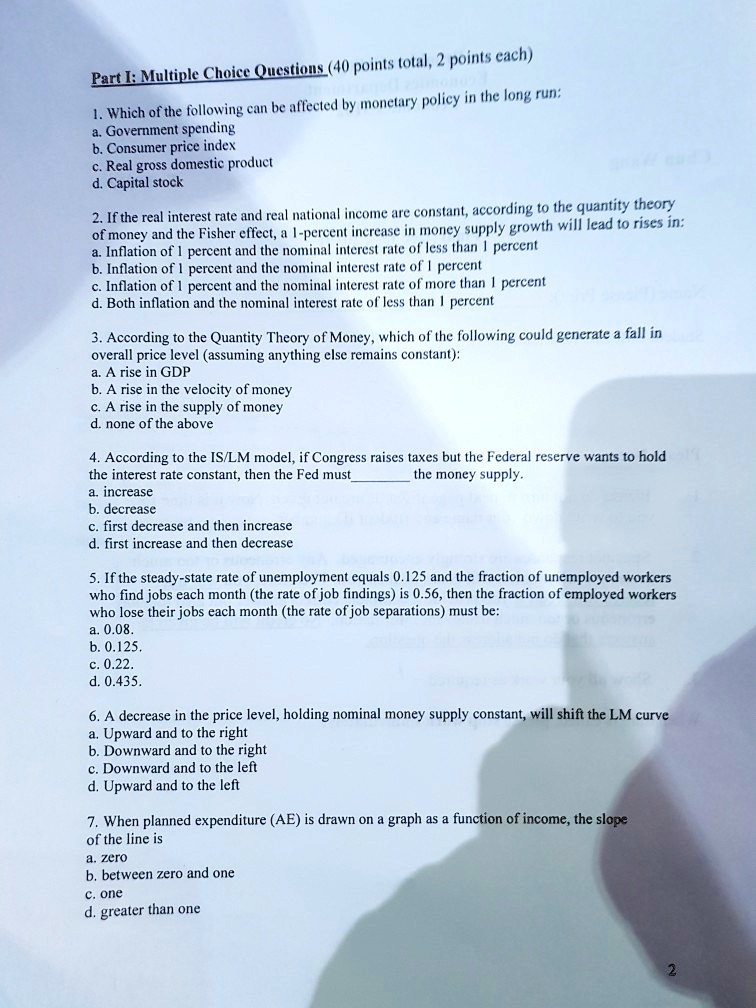
Part I: Multiple Choice Questions (40 points total, 2 points each)
1. Which of the following can be affected by monetary policy in the long run?
a. Government spending
b. Consumer price index
c. Real gross domestic product
d. Capital stock
2. If the real interest rate and real national income are constant, according to the quantity theory:
a. Inflation of 1 percent and the nominal interest rate of less than 1 percent
b. Inflation of 1 percent and the nominal interest rate of 1 percent
c. Inflation of 1 percent and the nominal interest rate of more than 1 percent
d. Both inflation and the nominal interest rate of less than 1 percent
3. According to the Quantity Theory of Money, which of the following could generate a fall in the overall price level (assuming anything else remains constant)?
a. A rise in GDP
b. A rise in the velocity of money
c. A rise in the supply of money
d. None of the above
4. According to the IS/LM model, if Congress raises taxes but the Federal Reserve wants to hold the interest rate constant, then the Fed must:
a. Increase the money supply
b. Decrease the money supply
c. First decrease and then increase the money supply
d. First increase and then decrease the money supply
5. If the steady-state rate of unemployment equals 0.125 and the fraction of unemployed workers who find jobs each month (the rate of job findings) is 0.56, then the fraction of employed workers who lose their jobs each month (the rate of job separations) must be:
a. 0.08
b. 0.125
c. 0.22
d. 0.435
6. A decrease in the price level, holding nominal money supply constant, will shift the LM curve:
a. Upward and to the right
b. Downward and to the right
c. Downward and to the left
d. Upward and to the left
7. When planned expenditure (AE) is drawn on a graph as a function of income, the slope of the line is:
a. Zero
b. Between zero and one
c. One
d. Greater than one