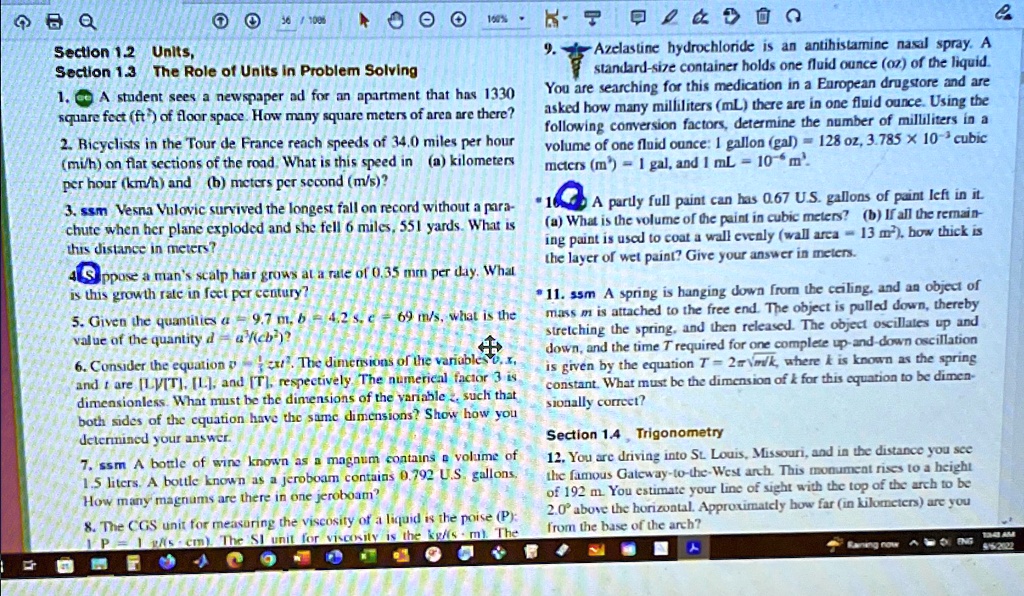
Section 1.2 Units, Section 1.3 The Role of Units in Problem Solving
A student sees a newspaper ad for an apartment that has 1330 square feet (ft^2) of floor space. How many square meters of area are there?
Bicyclists in the Tour de France reach speeds of 34.0 miles per hour (mi/h) on flat sections of the road. What is this speed in (a) kilometers per hour (km/h) and (b) meters per second (m/s)?
Vesna Vulovic survived the longest fall on record without a parachute when her plane exploded and she fell 6 miles, 551 yards. What is this distance in meters?
Suppose a man's scalp hair grows at a rate of 0.35mm per day. What is this growth rate in feet per century?
Given the quantities a=9.7m, b=4.2s, c=69(m/s), what is the value of the quantity d=(a^2)/(c^2)? and t are [L], [T], and [T], respectively. The numerical factor 3 is dimensionless. What must be the dimensions of the variable such that both sides of the equation have the same dimensions? Show how you determined your answer.
A bottle of wine known as a magnum contains a volume of 1.5 liters. A bottle known as a jeroboam contains 0.792 U.S gallons. How many magnums are there in one jeroboam?
The CGS unit for measuring the viscosity of a liquid is the poise (P): 1P=1(μ)/(s)*cm. The SI unit for viscosity is the Kg/(s*m).
If Azelastine hydrochloride is an antihistamine nasal spray. A standard-size container holds one fluid ounce (oz) of the liquid. You are searching for this medication in a European drugstore and are asked how many milliliters (mL) there are in one fluid ounce. Using the following conversion factors, determine the number of milliliters in a volume of one fluid ounce: 1 gallon (gal)=128 oz, 3.785*10^(-3) cubic meters (m^3)=1 gal, and 1mL=10^(-6)m^3.
A partly full paint can has 0.67 U.S. gallons of paint left in it. (a) What is the volume of the paint in cubic meters? (b) If all the remaining paint is used to coat a wall evenly (wall area=13m^2), how thick is the layer of wet paint? Give your answer in meters.
A spring is hanging down from the ceiling, and an object of mass m is attached to the free end. The object is pulled down, thereby stretching the spring, and then released. The object oscillates up and down, and the time T required for one complete up-and-down oscillation is given by the equation T=2π√(m/k), where k is known as the spring constant. What must be the dimension of k for this equation to be dimensionally correct?
Section 1.4, Trigonometry
You are driving into St. Louis, Missouri, and in the distance you see the famous Gateway-to-the-West arch. This monument rises to a height of 192m. You estimate your line of sight with the top of the arch to be 2.0° above the horizontal. Approximately how far (in kilometers) are you from the base of the arch?