Ace - AI Tutor
Ask Our Educators
Textbooks
My Library
Flashcards
Scribe - AI Notes
Notes & Exams
Download App
carrie james

carrie j.

Divider

Questions asked

BEST MATCH

Ca2+ ions which play an important role in muscle function, are reabsorbed in the Question 8 options: a) proximal tubule b) ascending loop of Henle c) glomerulus d) descending loop of Henle e) distal tubule

View Answer
divider
BEST MATCH

what type of information does each type of financial statement provide

View Answer
divider
BEST MATCH

Explain how ICD-10-CM has influenced clinical documentation practices. Evaluate the role of CDI programs in ensuring documentation accuracy.Propose strategies to enhance CDI efforts in light of the changes brought by ICD-10-CM

View Answer
divider
BEST MATCH

You’ve been given a task of evaluating the performance of a compressor. Air is compressed from a temperature of 15.0 oC and local atmospheric pressure to a final temperature of 326 oC and final pressure of 409 kPa gauge. The mass flow rate of the air is 6.83 kg/s and it remains constant. Assume the air has constant specific heat capacity Cp of 1.065 kJ/kg.K, and Cv of 0.730 kJ/kg.K. The compressor is not very well insulated and 3.1kW of heat is lost through the compressor housing at a boundary temperature of 85oC. Assume negligible changes in kinetic and potential energy of the air. The local atmospheric pressure is 100.88 kPa. Now estimate the rate of entropy generation (kW/K) while the air is compressed. (Answer must be in 2 decimals)

View Answer
divider
BEST MATCH

Which ligament of the knee prevents anterior movement of the femur and maintains the alignment of the femoral and tibial condyles? a)lateral collateral ligament b)posterior cruciate ligament c)medial collateral ligament d)anterior cruciate ligament a d b c

View Answer
divider
BEST MATCH

Which of the following is NOT true about complement proteins? Which of the following is NOT true about complement proteins? They are too large to pass though the capillaries, so they cannot diffuse to attack pathogens They are a group of approximately 20 different plasma proteins Once activated they stimulate a cascade of reactions creating holes in pathogens, and the release of histamine & other phagocytes They can “tag” bacterial cells, marking them to be identified then destroyed by phagocytes

View Answer
divider
BEST MATCH

Question opsne reactes with oxygen gas to produce isrbonclioxide and water as shown in the reaction below (5) How much energy in \( k J \) will be relessed if \( 500 \mathrm{~kg} \) of propane is burned in air?

View Answer
divider
BEST MATCH

2. For the given truss supported by a pin at A and roller at D: (34 pts) a) Identify all the zero force members b) Solve for all the member forces using the Method of Joints. State whether each member is in T or C.

View Answer
divider
BEST MATCH

8.1 Variational principle with a parameter The point of this problem is not to do something as complicated as a molecule, but to show you an example of how you can guess a wavefunction with a free parameter, vary the parameter, and get a pretty good answer. In this case it should be great, since we know the exact answer: the ground state of the hydrogen atom goes like $e^{-r/a}$---Equation (4.80) in either edition of the textbook---and the energy is -13.6 eV. You might guess that the wavefunction is something like $Ae^{-\mu r}$, where A is a normal- ization constant and the constant $\mu$ controls how fast the wavefunction asymptotes to zero. Note that these constants will be related. (a) Normalize this wavefunction and use it to get a bound on the ground state energy as a function of $\mu$. (b) Find the minimum of your energy estimate with respect to $\mu$ and compare it to the Bohr energy -13.6 eV.

View Answer
divider
BEST MATCH

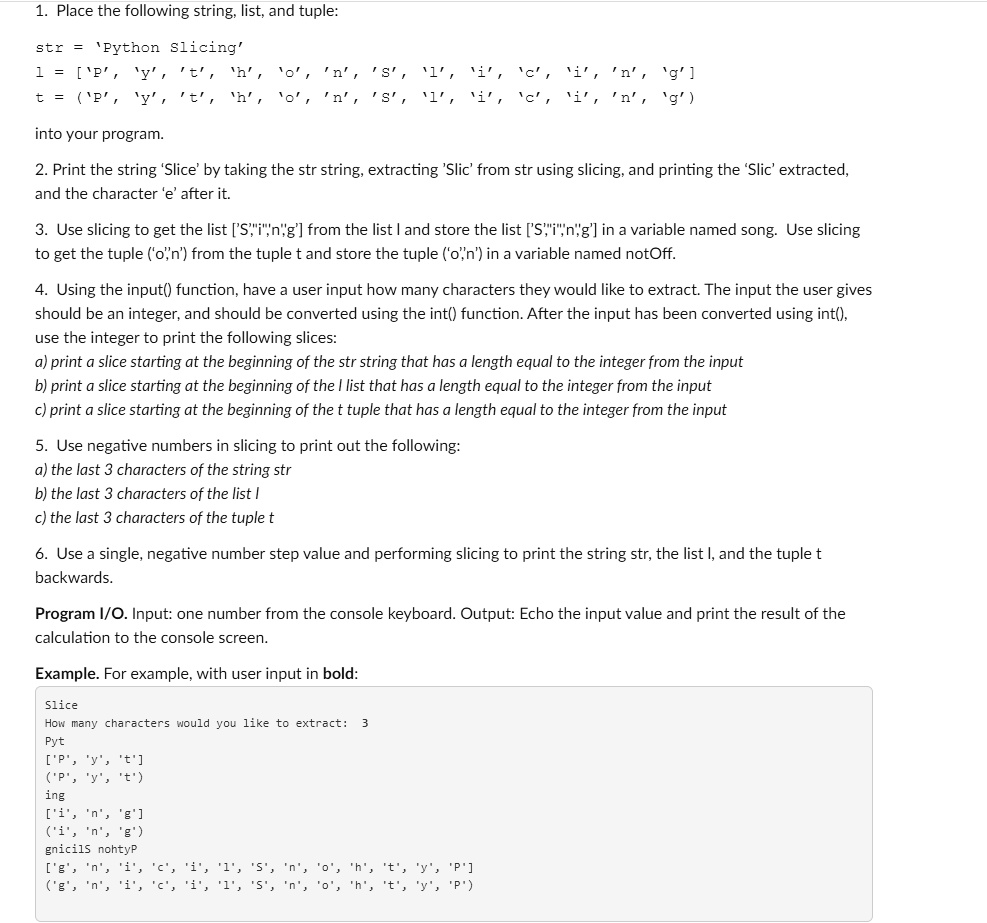
Place the following string, list, and tuple: str = 'Python slicing' l = ['p', 'y', 't', 'h', 'o', 'n', 's', 'l', 'i', 'c', 'i', 'n', 'g'] t = ('p', 'y', 't', 'h', 'o', 'n', 's', 'l', 'i', 'c', 'i', 'n', 'g') into your program. 2. Print the string 'Slice' by taking the str string, extracting 'Slic' from str using slicing, and printing the 'Slic' extracted, and the character 'e' after it. 3. Use slicing to get the list ['Si"ng'] from the list l and store the list ['Si"n"g'] in a variable named song. Use slicing to get the tuple ('o', 'n') from the tuple t and store the tuple ('on') in a variable named notOff. 4. Using the input() function, have a user input how many characters they would like to extract. The input the user gives should be an integer, and should be converted using the int() function. After the input has been converted using int(), use the integer to print the following slices: a) Print a slice starting at the beginning of the str string that has a length equal to the integer from the input. b) Print a slice starting at the beginning of the l list that has a length equal to the integer from the input. c) Print a slice starting at the beginning of the t tuple that has a length equal to the integer from the input. 5. Use negative numbers in slicing to print out the following: a) The last 3 characters of the string str. b) The last 3 characters of the list l. c) The last 3 characters of the tuple t. 6. Use a single, negative number step value and perform slicing to print the string str, the list l, and the tuple t backwards. Program I/O. Input: one number from the console keyboard. Output: Echo the input value and print the result of the calculation to the console screen. Example. For example, with user input in bold: Slice How many characters would you like to extract: 3 Pyt ['p', 'y', 't'] ing ['i', 'n', 'g'] gnicilS nohtyP ['g', 'n', 'i', 'c', 'i', 'l', 's', 'n', 'o', 'h', 't', 'y', 'P'] 'g', 'n', 'i', 'c', 'i', 'l', 'S', 'n', 'o', 'h', 't', 'y', 'P
View Answer
divider