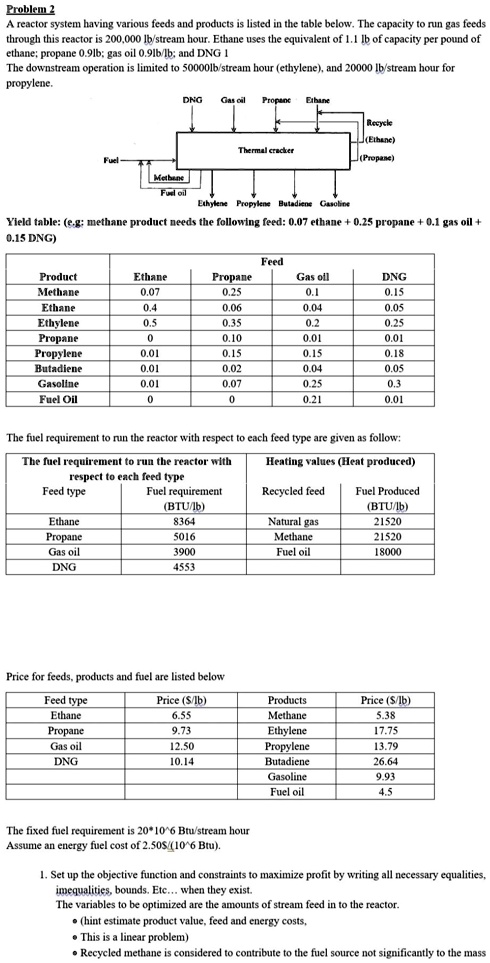
Problem 2
Through this reactor, the flow rate is 200,000 lb/stream hour. Ethane uses the equivalent of 1.1 lb of capacity per pound of ethane; propane 0.9 lb; gas oil 0.9 lb/lb; and DNG 1.
The downstream operation is limited to 50,000 lb/stream hour (ethylene) and 20,000 lb/stream hour for propylene.
DNG Gas oil Ethane
Recycle
(Ethane)
Thermal cracker
(Propane)
Methane Fuel oil Ethylene Propylene Butadiene Gasoline
Yield table: (e.g. methane product needs the following feed: 0.07 ethane + 0.25 propane + 0.1 gas oil + 0.15 DNG)
Feed Propane Gas oil 0.25 0.1 0.06 0.0 0.35 0.2 0.1 1.0 0.15 0.15 0.02 0.04 0.07 0.25 0 0.21
Product Methane Ethane Ethylene Propane Propylene Butadiene Gasoline Fuel Oil
Ethane 0.07 0.4 0.5 0 0.01 0.01 0.01 0
DNG 0.15 0.05 0.25 0.01 0.18 0.05 0.3 0.01
The fuel requirement to run the reactor with respect to each feed type is given as follows:
Feed type Fuel requirement (BTU/lb)
Ethane 8364
Propane 5016
Gas oil 3900
DNG 4553
Heating values (Heat produced):
Recycled feed
Fuel Produced (BTU/lb) 21520 21520 18000
Natural gas Methane Fuel oil
Price for feeds, products, and fuel are listed below:
Feed type Ethane Propane Gas oil DNG
Price ($/lb) 6.55
Products Methane Ethylene Propylene Butadiene Gasoline Fuel oil
Price ($/lb) 5.38 17.75 13.79 26.64 9.93 4.5 12.50 10.14
The fixed fuel requirement is 20*10^6 Btu/stream hour. Assume an energy fuel cost of 2.50S/(10^6 Btu).
1. Set up the objective function and constraints to maximize profit by writing all necessary equalities, inequalities, bounds, etc., when they exist. The variables to be optimized are the amounts of stream feed into the reactor. (Hint: estimate product value, feed and energy costs. This is a linear problem.) Recycled methane is considered to contribute to the fuel source, not significantly to the mass.