Exercise 2: Entry Into a Monopolized Industry
The inverse market demand is
$P^D(Q) = \begin{cases} 0 & \text{if } Q \ge 220 \\ 220 - Q & \text{if } Q < 220 \end{cases}$
where $Q = \sum_{i \in I} q_i$ is the total quantity produced.
There are two firms with identical variable cost functions $c_i(q_i) = 10q_i$.
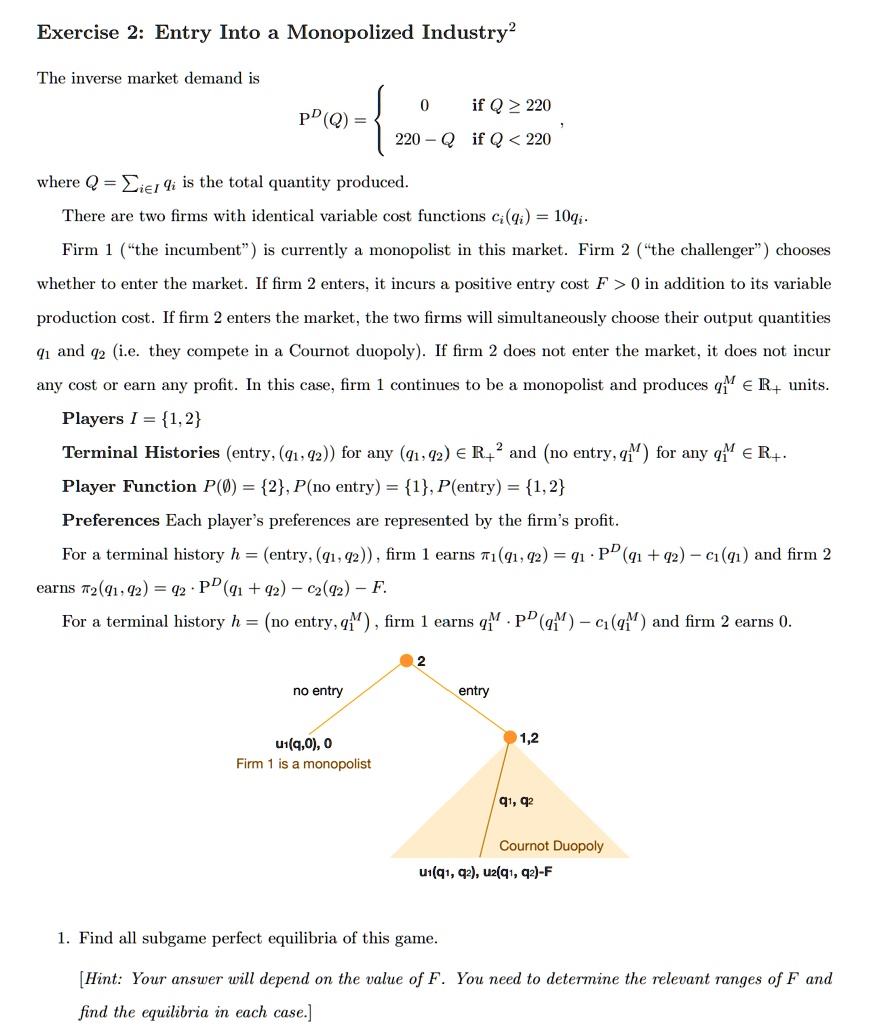
Firm 1 ("the incumbent") is currently a monopolist in this market. Firm 2 ("the challenger") chooses whether to enter the market. If firm 2 enters, it incurs a positive entry cost $F > 0$ in addition to its variable production cost. If firm 2 enters the market, the two firms will simultaneously choose their output quantities $q_1$ and $q_2$ (i.e., they compete in a Cournot duopoly). If firm 2 does not enter the market, it does not incur any cost or earn any profit. In this case, firm 1 continues to be a monopolist and produces $q^M \in \mathbb{R}_+$ units.
Players $I = \{1, 2\}$
Terminal Histories (entry, $(q_1, q_2)$) for any $(q_1, q_2) \in \mathbb{R}_+^2$ and (no entry, $q^M$) for any $q^M \in \mathbb{R}_+$.
Player Function $P(\emptyset) = \{2\}$, $P(\text{no entry}) = \{1\}$, $P(\text{entry}) = \{1, 2\}$
Preferences Each player's preferences are represented by the firm's profit.
For a terminal history $h = (\text{entry}, (q_1, q_2))$, firm 1 earns $\pi_1(q_1, q_2) = q_1 P^D(q_1 + q_2) - c_1(q_1)$ and firm 2 earns $\pi_2(q_1, q_2) = q_2 P^D(q_1 + q_2) - c_2(q_2) - F$.
For a terminal history $h = (\text{no entry}, q^M)$, firm 1 earns $\pi_1^M = q^M P^D(q^M) - c_1(q^M)$ and firm 2 earns 0.
1. Find all subgame perfect equilibria of this game.
[Hint: Your answer will depend on the value of F. You need to determine the relevant ranges of F and find the equilibria in each case.]