Ace - AI Tutor
Ask Our Educators
Textbooks
My Library
Flashcards
Scribe - AI Notes
Notes & Exams
Download App
cassandra harris

cassandra h.

Divider

Questions asked

BEST MATCH

Unproctored Placement Assessment Question 6 Simplify. (-4x^(4)y^(-6))^(2) Write your answer using only positive exponents

View Answer
divider
BEST MATCH

Question 24 The most conspicuous medusa stage is found in the class Hydrozoa. Scyphozoa. Anthozoa. Ctenophora. Cubozoa. 0.47 pts

View Answer
divider
BEST MATCH

1. You are trying to feed your cows but keep feeds costs low. You know your cows need 9% Crude Protein and a TDN of 58%. You are feeding some Sorghum Sudan Hay (9% CP and 52% TDN) and first cutting Alfalfa (9% CP and 63% TDN). Your cows require about 30 pounds a day of feed. How many pounds of each will you feed to meet both a CP and TDN requirement?

View Answer
divider
BEST MATCH

An initially neutral rubber rod is rubbed against wool. After the rubbing, the rod has a charge of -3.1 nC. What happened when these objects were rubbed together? Electrons were transferred from the wool to the rubber. How many of these particles were transferred? 1.9375x10^10 A glass rod has an initial charge of +1.5 nC. This glass rod is rubbed against silk. After the rubbing, the rod has a charge of +5.3 nC. What happened when these objects were rubbed together? Electrons were transferred from the glass to the silk. How many of these particles were transferred?

View Answer
divider
BEST MATCH

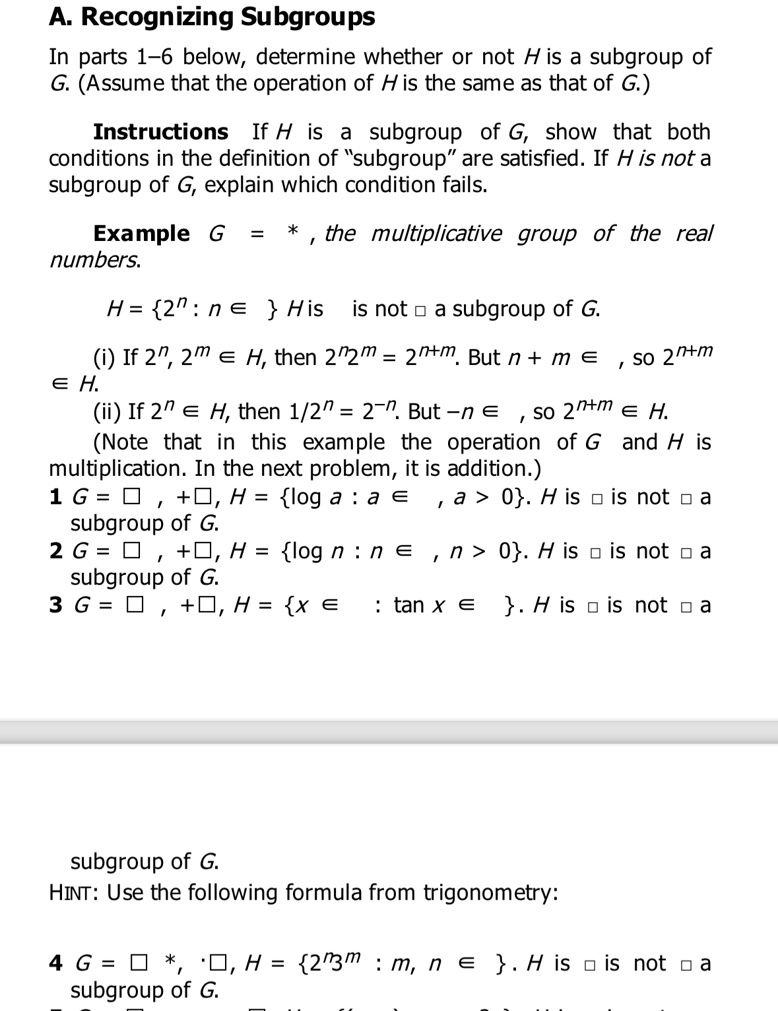
A. Recognizing Subgroups In parts 1-6 below, determine whether or not $H$ is a subgroup of $G$. (Assume that the operation of $H$ is the same as that of $G$.) Instructions If $H$ is a subgroup of $G$, show that both conditions in the definition of "subgroup" are satisfied. If $H$ is not a subgroup of $G$, explain which condition fails. Example $G = *$, the multiplicative group of the real numbers. $H = \{2^n : n \in \mathbb{Z} \}$. $H$ is not a subgroup of $G$. (i) If $2^n$, $2^m \in H$, then $2^n 2^m = 2^{n+m}$. But $n + m \in \mathbb{Z}$, so $2^{n+m} \in H$. (ii) If $2^n \in H$, then $1/2^n = 2^{-n}$. But $-n \in \mathbb{Z}$, so $2^{-n} \in H$. (Note that in this example the operation of $G$ and $H$ is multiplication. In the next problem, it is addition.) 1 $G = \mathbb{R}$, $+$, $H = \{\log a : a \in \mathbb{R}, a > 0\}$. $H$ is not a subgroup of $G$. 2 $G = \mathbb{R}$, $+$, $H = \{\log n : n \in \mathbb{N}, n > 0\}$. $H$ is not a subgroup of $G$. 3 $G = \mathbb{R}$, $+$, $H = \{x \in \mathbb{R} : \tan x \in \mathbb{Z}\}$. $H$ is not a subgroup of $G$. HINT: Use the following formula from trigonometry: 4 $G = \mathbb{R}$, $*$, $H = \{2^{n3^m} : m, n \in \mathbb{Z}\}$. $H$ is not a subgroup of $G$.
View Answer
divider
BEST MATCH

7.6 For the unit step response shown in Fig. E7.6, estimate the following models using graphical methods: (a) First-order plus time delay. (b) Second-order using Smith's method and nonlinear regression. Plot all three predicted model responses on the same graph. Figure E7.6

View Answer
divider
BEST MATCH

1. \( f(x)=\cos \left(2 x^{3}+5\right) \)

View Answer
divider
BEST MATCH

True or false because the heartbeats continuously, cardiac fibers could never relax completely

View Answer
divider
BEST MATCH

Chemically, ATP is of the class of molecules known as: Nucleosides Proteins Carbohydrates Lipids None of the above

View Answer
divider
BEST MATCH

Question 2: A survey is conducted to estimate the average amount spent on utilities for households in a city. 20 clusters are selected by SRSWOR from 60 clusters of the city. Interviewers then obtain the cost of utilities from each household within the sampled clusters; the total costs are shown in the accompany table. \begin{tabular}{|l|c|c|l|c|c|} \hline \begin{tabular}{l} Sampled \\ Cluster \end{tabular} & \begin{tabular}{l} Number of \\ households \end{tabular} & \begin{tabular}{l} Total amount \\ Spent on utilities \end{tabular} & \begin{tabular}{l} Sampled \\ Cluster \end{tabular} & \begin{tabular}{l} Number of \\ households \end{tabular} & \begin{tabular}{l} Total amount \\ Spent on utilities \end{tabular} \\ \hline 1 & 55 & 2210 & 11 & 73 & 2930 \\ \hline 2 & 60 & 2390 & 12 & 64 & 2470 \\ \hline 3 & 63 & 2430 & 13 & 69 & 2830 \\ \hline 4 & 58 & 2380 & 14 & 58 & 2370 \\ \hline 5 & 71 & 2760 & 15 & 63 & 2390 \\ \hline 6 & 78 & 3110 & 16 & 75 & 2870 \\ \hline 7 & 69 & 2780 & 17 & 78 & 3210 \\ \hline 8 & 58 & 2370 & 18 & 51 & 2430 \\ \hline 9 & 52 & 1990 & 19 & 67 & 2730 \\ \hline 10 & 71 & 2810 & 20 & 70 & 2880 \\ \hline \end{tabular} (a) Estimate the average amount a household in the city spends on utilities. (b) Construct a \( 95 \% \) C.I. for the average amount with an unbiased estimate of the variance. (c) Find an unbiased estimate for the total amount spent on utilities of all households in the city. (d) Determine a bound \( B_{a} \) on the absolute error of estimating the total amount with a probability of 0.95 and an unbiased estimate of the variance. (e) Use (d) to construct a \( 95 \% \) C.I. for the total amount. Use \( z_{0.025}=1.96 \) to answer Question 2.

View Answer
divider