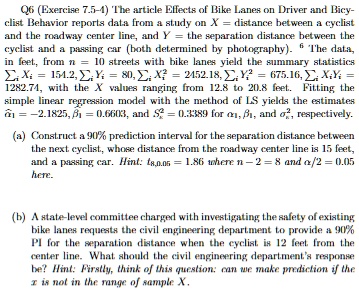
Q6 (Exercise 7.5-4) The article "Effects of Bike Lanes on Driver and Cyclist Behavior" reports data from a study on X = distance between a cyclist and the roadway center line, and Y = the separation distance between the cyclist and a passing car (both determined by photography). The data, in feet, from n = 10 streets with bike lanes yield the summary statistics: X = 154.2, Y = 80, XÌ„ = 2452.18, Ȳ = 675.16, and XY = 1282.74, with the X values ranging from 12.8 to 20.8 feet. Fitting the simple linear regression model with the method of ILS yields the estimates β̂₀ = 2.1825, β̂₠= 0.6603, and S = 0.3389 for β₀, βâ‚, and σ, respectively.
(a) Construct a 90% prediction interval for the separation distance between the next cyclist, whose distance from the roadway center line is 15 feet, and a passing car. Hint: tₛ,₀.₀₅ = 1.86 where n - 2 = 8 and α/2 = 0.05 here.
(b) A state-level committee charged with investigating the safety of existing bike lanes requests the civil engineering department to provide a 90% prediction interval for the separation distance when the cyclist is 12 feet from the center line. What should the civil engineering department's response be? Hint: Firstly, think of this question: Can we make a prediction if the z is not in the range of sample X.