Questions asked
Protein kinase A and calcium/calmodulin-dependent kinase can elicit changes in gene transcription through phosphorylation of [c-fos/c-jun/CREB/ras]. The resulting changes in protein expression are typically sustained for several [seconds / minutes / hours / days].
Arrange the steps of DNA replication in the order that they occur. First step Helicase unwinds the DNA double helix. RNA primers are added. Single-stranded DNA-binding proteins bind to each template strand. DNA polymerase synthesizes DNA. RNA primers are removed. DNA ligase joins DNA fragments together. Last step Answer Bank
If In $K'_{eq}$ is positive, $\Delta G^{\circ'}$ will be positive and the reaction will be at equilibrium. $\Delta G^{\circ'}$ will be negative and the reaction will not proceed. $\Delta G^{\circ'}$ will be negative and the reaction will be at equilibrium. $\Delta G^{\circ'}$ will be negative and the reaction will be spontaneous.
What factors play significant roles in eyewitness reliability for both children and adults? Group of answer choices Memory strategies and source monitoring Question phrasing and familiarity Developmental differences and cognitive resources Context, suggestibility, and memory processes
08 Question (8 points) Open Ebook section 30.6 A classic game of commitment by teenagers is chicken, in which two young people drive toward each other in cars, each committing to staying straight and hoping the other will be the first to swerve (the "chicken"). This game is modeled in the normal-form box below. Teenager 2 Chicken Stay straight Swerve Teenager 1 Stay straight -50, -50 10, -5 Swerve -5, 10 0, 0 7th attempt Part 1 (2.7 points) Identify any pure strategy equilibria of this game. Choose one or more: A. (straight, straight) B. There are no pure strategy equilibria. C. (straight, swerve) D. (swerve, straight) E. (swerve, swerve)
a cd has a mass of 0.017 kg and a radius of 0.06 m. When inserted into a player, the CD rest and accelerates to an angular velocity of 16 rad /s in 0.45 s. Assuming the CD , determine the net torque acting on it. ( tau=I alpha, ; I= 1 2 MR^ 2
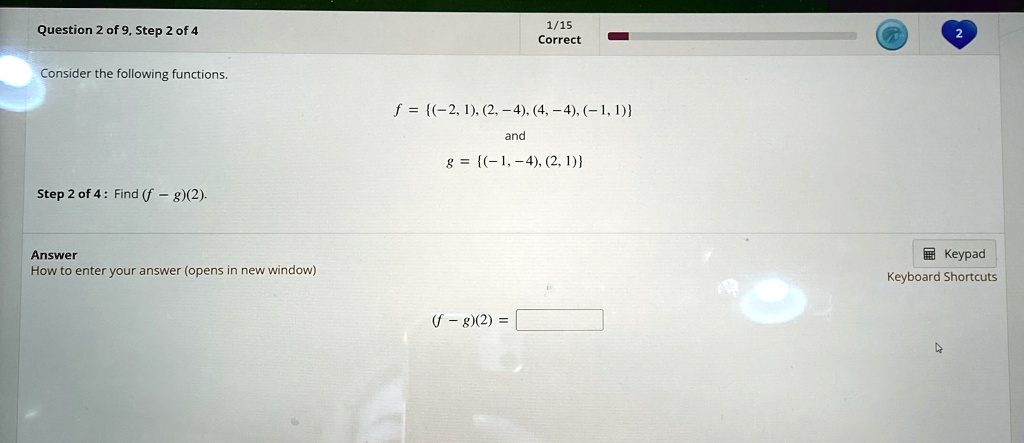
Question 2 of 9, Step 2 of 4 Consider the following functions. f = \{(-2, 1), (2, -4), (4, -4), (-1, 1)\} and g = \{(-1, -4), (2, 1)\} Step 2 of 4: Find $(f - g)(2)$. Answer How to enter your answer (opens in new window) $(f - g)(2) = $
Your firm currently pays a quarterly dividend of $1.35. You are planning on doubling this dividend but then keeping it flat for the next three years, after which it is expected to increase at the industry standard rate of 4 percent per year indefinitely. Your required rate of return on your company’s stock is 12.5 percent, and the last $1.35 dividend was just paid. What will be the time value of money impact on your stock price if investors are fully informed concerning your future intentions for all dividends? What will be the present value of all expected future dividends if you don’t tell the investors that you will be keeping the quarterly dividend constant for the first three years, and they assume after the fifth coming dividend that dividends will remain at $2.70 indefinitely?
A professor shipwrecked on Hooligan's Island decides to build a telescope from his eyeglasses and some coconut shells. Fortunately, the professor's eyes require different prescriptions, with the left lens having a power of 4.8 diopters and the right lens having a power of 1.6 diopters. \text{Part A} Which lens should he use as the objective? left lens right lens Submit Previous Answers \text{Correct} \text{Part B} What is the angular magnification of the professor's telescope? Express your answer using two significant figures. $M_{\text{total}} = $ Submit Previous Answers Request Answer Incorrect; Try Again; 4 attempts remaining Provide Feedback
In some molluscs, the free-swimming larva is a trochophore while in others, it is a veliger with the beginnings of a foot, shell and mantle. What is the relationship of these molluscan juvenile stages? Only the cephalopods have the veliger stage; all other molluscs have a trochophore stage. The veliger is ancestral and the trochophore is a derived larval stage. The two larval forms represent two early and distinct branches of molluscs. A veliger is found strictly in terrestrial molluscs. The trochophore is considered ancestral and the veliger is a derived larval stage.