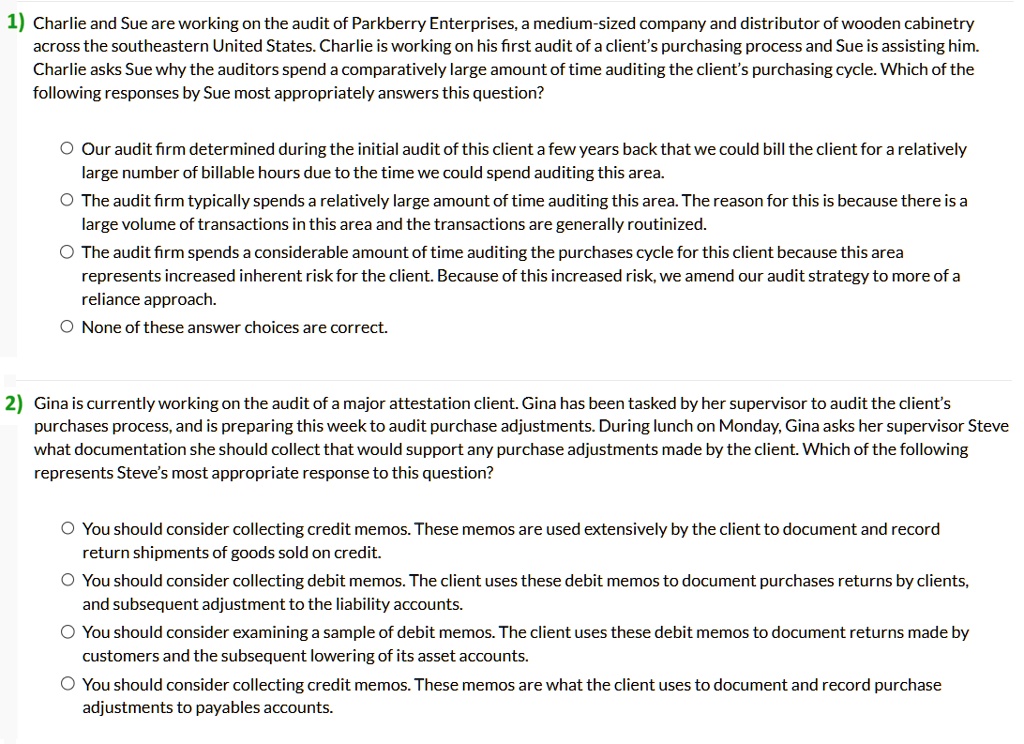
1) Charlie and Sue are working on the audit of Parkberry Enterprises, a medium-sized company and distributor of wooden cabinetry
across the southeastern United States. Charlie is working on his first audit of a client's purchasing process and Sue is assisting him.
Charlie asks Sue why the auditors spend a comparatively large amount of time auditing the client's purchasing cycle. Which of the
following responses by Sue most appropriately answers this question?
Our audit firm determined during the initial audit of this client a few years back that we could bill the client for a relatively
large number of billable hours due to the time we could spend auditing this area.
The audit firm typically spends a relatively large amount of time auditing this area. The reason for this is because there is a
large volume of transactions in this area and the transactions are generally routinized.
The audit firm spends a considerable amount of time auditing the purchases cycle for this client because this area
represents increased inherent risk for the client. Because of this increased risk, we amend our audit strategy to more of a
reliance approach.
None of these answer choices are correct.
2) Gina is currently working on the audit of a major attestation client. Gina has been tasked by her supervisor to audit the client's
purchases process, and is preparing this week to audit purchase adjustments. During lunch on Monday, Gina asks her supervisor Steve
what documentation she should collect that would support any purchase adjustments made by the client. Which of the following
represents Steve's most appropriate response to this question?
You should consider collecting credit memos. These memos are used extensively by the client to document and record
return shipments of goods sold on credit.
You should consider collecting debit memos. The client uses these debit memos to document purchases returns by clients,
and subsequent adjustment to the liability accounts.
You should consider examining a sample of debit memos. The client uses these debit memos to document returns made by
customers and the subsequent lowering of its asset accounts.
You should consider collecting credit memos. These memos are what the client uses to document and record purchase
adjustments to payables accounts.