Ace - AI Tutor
Ask Our Educators
Textbooks
My Library
Flashcards
Scribe - AI Notes
Notes & Exams
Download App
catherine valle

catherine v.

Divider

Questions asked

BEST MATCH

Which of the following is a shared ancestral trait that platypuses share with other mammals? O teats O mammary glands O venom O none of the above

View Answer
divider
BEST MATCH

Your patient has a subdural hematoma. The most likely cause of this condition in an 84 year old is

View Answer
divider
BEST MATCH

What orbitals overlap to form a NH bond in a NH3 molecule?An sp2 orbital in N overlaps with the sp orbitals in H to form the NH bond.An sp3 orbital in N overlaps with the s orbital in H to form the NH bond.An sp3 orbital in N overlaps with the sp2 orbitals in H to form the NH bond.An sp2 orbital in N overlaps with the s orbital in H to form the NH bond.

View Answer
divider
BEST MATCH

Which of the following may lead to atelectasis? (choose all that apply) Supplemental oxygen Walking General Anesthesia Coughing Shallow breathing due to pain or narcotics Which of the following may lead to atelectasis? (choose all that apply) Supplemental oxygen Walking General Anesthesia Coughing Shallow breathing due to pain or narcotics

View Answer
divider
BEST MATCH

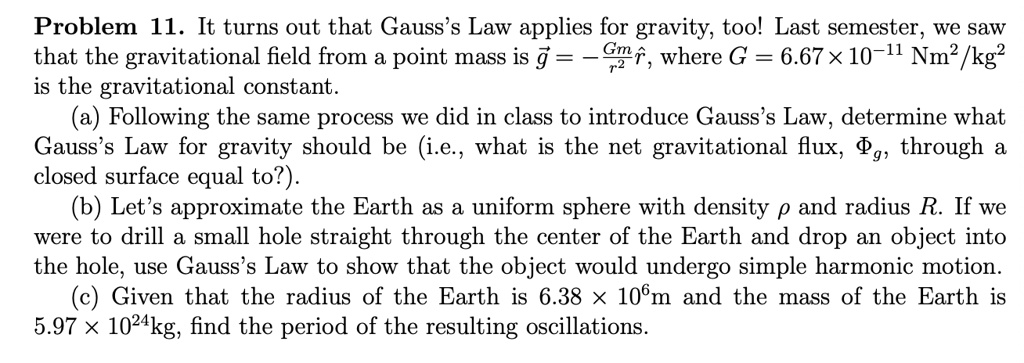
Problem 11. It turns out that Gauss's Law applies for gravity, too! Last semester, we saw that the gravitational field from a point mass is $\vec{g} = -\frac{Gm}{r^2}\hat{r}$, where $G = 6.67 \times 10^{-11} Nm^2/kg^2$ is the gravitational constant. (a) Following the same process we did in class to introduce Gauss's Law, determine what Gauss's Law for gravity should be (i.e., what is the net gravitational flux, $\Phi_g$, through a closed surface equal to?). (b) Let's approximate the Earth as a uniform sphere with density $\rho$ and radius $R$. If we were to drill a small hole straight through the center of the Earth and drop an object into the hole, use Gauss's Law to show that the object would undergo simple harmonic motion. (c) Given that the radius of the Earth is $6.38 \times 10^6 m$ and the mass of the Earth is $5.97 \times 10^{24} kg$, find the period of the resulting oscillations.
View Answer
divider
BEST MATCH

What quantity will the sellers be able to sell after the imposition of the price floor?

View Answer
divider
BEST MATCH

What concentration in μg/L of the odorless, gas toxicant 'forever-hover' in the air of a 2,000 cubic meter avian facility will be required to achieve a dose of 5 μg/Kg in each of 10 hummingbirds in one hour exposure time? Assume each hummingbird weighs 50g, hummingbirds breathe at the rate of 200 breaths per minute, the volume of each hummingbird breath is 1 mL, and the inhalation absorption rate is 50% in hummingbirds.

View Answer
divider
BEST MATCH

4. Let A = {x | x is a Natural number ? 10} B = {x| 0 < x is even number ?10} C = {x| 0 < x is odd number < 10} Find a) A - B b) B - C c) C - A d) A - C

View Answer
divider
BEST MATCH

Question 4 (6 points) A grammar with the following productions can produce one of the following strings. Which is it? $S \rightarrow aaA$, $A \rightarrow bS$, $S \rightarrow \lambda$. aabaab baa aaba aba bbaaaa

View Answer
divider
BEST MATCH

The short freight train in the figure consists of a locomotive L of mass $m_L = 100$ tonnes and two iron-ore wagons A and B, each of mass $m_W = 50$ tonnes. Note that 1 tonne is equal to 1000 kg. The locomotive exerts a constant tractive force $F = 100$ kN on the rails as the train starts from rest. There is $s = 0.3$ m of slack in each of the couplings between the locomotive and wagons. Immediately after each coupling becomes tight the two coupled vehicles have the same velocity; that is the coupling becoming tight can be treated in the same way as a collision with a coefficient of restitution $e = 0$. link to image Calculate the following: (a) the velocity of the locomotive just before coupling 1 between the locomotive and wagon A becomes tight; (a) 0.77 m/s (b) the joint velocity of the locomotive and wagon A just after coupling 1 becomes tight; (b) 0.52 m/s (c) the joint velocity of the locomotive and wagon A just before coupling 2 between wagon A and wagon B becomes tight. (c) 0.82 m/s

View Answer
divider