The answer and the simple process of solving are already presented, so you need to understand the problem and fill out the detailed process of solving it. (CAUTION) It is a matter of obtaining Q, W, ΔU for each stage, including obtaining ΔH for each stage and showing that H is a state function. *Please write it correctly, there are a lot of letters that I don't recognize.
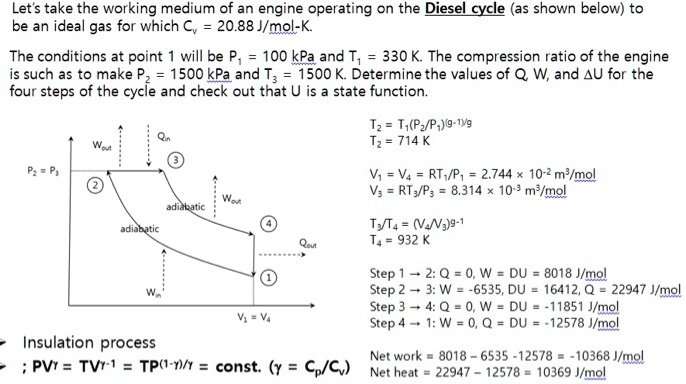
Let's take the working medium of an engine operating on the Diesel cycle (as shown below) to be an ideal gas for which C = 20.88 J/mol-K. The conditions at point 1 will be P = 100 kPa and T = 330 K. The compression ratio of the engine is such as to make P = 1500 kPa and T = 1500 K. Determine the values of Q, W, and U for the four steps of the cycle and check that U is a state function.
T = T_P / (P_g - 1) / g
T = 714 K
W_o
P = P_3
V = V = RT / P = 2.744 * 10^-2 m^3/mol
V = RT / P = 8.314 * 10^-3 m^3/mol
T / T_4 = (V / V)^(g - 1)
T_4 = 932 K
Q_ov
Step 1-2: Q = 0, W = ΔU = 8018 J/mol
Step 2-3: W = -6535, ΔU = 16412, Q = 22947 J/mol
Step 3-4: Q = 0, W = ΔU = -11851 J/mol
Step 4-1: W = 0, Q = ΔU = -12578 J/mol
W_i
V = V_4
Insulation process
Network = 8018 - 6535 - 12578 = -10368 J/mol
PVY = TV^(1 - γ) = TP(1 - γ) = const. = C / C
Net heat = 22947 - 12578 = 10369 J/mol