Ace - AI Tutor
Ask Our Educators
Textbooks
My Library
Flashcards
Scribe - AI Notes
Notes & Exams
Download App
celia williams

celia w.

Divider

Questions asked

BEST MATCH

Question 3 Table 10-1 Disposable Income (Yd) Consumption (C) $2,000 $2,040 2,100 2,120 2,200 2,200 2,300 2,280 2,400 2,360 Refer to Table 10-1. When disposable income equals $2,000, saving equals A -$20. B -$40. C 0. D $40. 1 Point

View Answer
divider
BEST MATCH

If both of your parents have Achondroplasia (dwarfism), you will definitely have the condition too. Group of answer choices True False

View Answer
divider
BEST MATCH

the neuron which transmits information from the receptor to the central nervous system

View Answer
divider
BEST MATCH

Objects A and B are attached to a circular platform of radius R that is rotating under constant angular acceleration in the direction shown. The center of the platform is indicated with the red dot. The distance of Object A from the center is 1/3 R. The angular velocity of Object A is ____ times that of Object B?

View Answer
divider
BEST MATCH

What had happened to the child since her last visit several years earlier? Why did the author use numbers to refer to people in her study, instead of their names?

View Answer
divider
BEST MATCH

A steady-flow Carnot cycle uses water as the working fluid. Water changes from saturated liquid to saturated vapor as heat is transferred to it from a source at 230.0°C. Heat rejection takes place at a pressure of 10 kPa. Determine the amount of heat rejected.

View Answer
divider
BEST MATCH

Which is true about innervation of the right LGN? Choose ALL that apply. The right LGN only receives input from the left eye. The right LGN only receives input from the left visual field. The right LGN receives input from nasal RGCs in the right eye. The right LGN receives input from nasal RGCs in the left eye. The right LGN receives input from temporal RGCs in the left eye. The right LGN receives input from temporal RGCs in the right eye.

View Answer
divider
BEST MATCH

Homework 1 Please calculate the Earth Radiative Equilibrium Temperature. What would it be if the distance between Earth and Sun will be equal to 2 AU and 0.9 AU? Do not account for the albedo feedback, but discuss qualitatively how it could change the results. For the case of small changes of Solar Constant, try to use the climate sensitivity approach. Use the energy equilibrium equation and unperturbed solar constant as given below: $(1 - A) \times S_0 / 4 = \sigma T_E^4$ $S_0 = 1368 Wm^{-2}$ - Solar const. $\sigma = 5.7 \times 10^{-8} Wm^{-2}K^{-4}$ - Stefan – Boltzmann $A = 0.3$ - Earth's planetary albedo $T_E$ - Earth's radiative equilibrium T

View Answer
divider
BEST MATCH

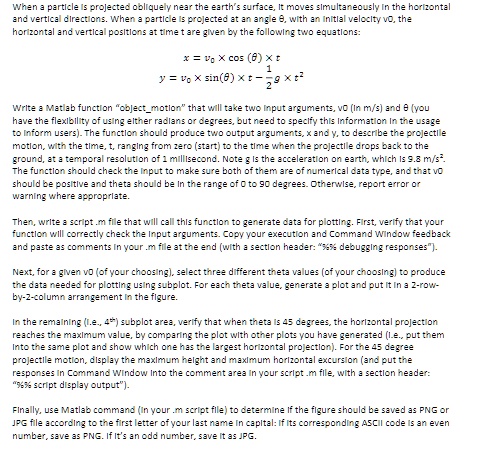
Answer this question in MATLAB When a particle is projected obliquely near the Earth's surface, it moves simultaneously in the horizontal and vertical directions. When a particle is projected at an angle θ, with an initial velocity vo, the horizontal and vertical positions at time t are given by the following two equations: x = vo * cos(θ) * t y = vo * sin(θ) * t - (1/2) * g * t^2 Write a MATLAB function object_motion that will take two input arguments, vo (in m/s) and θ (you have the flexibility of using either radians or degrees, but need to specify this information in the usage to inform users). The function should produce two output arguments, x and y, to describe the projectile's motion over time. The function should calculate the positions of the projectile at a temporal resolution of 1 millisecond. Note that g is the acceleration on Earth, which is 9.8 m/s^2. The function should check the input to make sure both of them are of numerical data type, and provide a warning where appropriate. Then, write a script .m file that will call this function to generate data for plotting. First, verify that your function is working correctly by displaying the output values for a specific input (vo and θ) and paste them as comments in your .m file at the end (with a section header: %% debugging responses). Next, for a given vo (of your choosing), select three different θ values (of your choosing) to produce the data needed for plotting using subplot. For each θ value, generate a plot and put it in a 2-row-by-2-column arrangement in the figure. In the remaining (i.e., 4th) subplot area, verify that when θ is 45 degrees, the horizontal projection reaches the maximum value, by comparing the plot with other plots you have generated (i.e., put the responses in the Command Window into the comment area in your script .m file, with a section header: "%% script display output"). Finally, use the MATLAB command (in your .m script file) to determine if the figure should be saved as PNG or JPG. If it's an even number, save as PNG. If it's an odd number, save it as JPG.
View Answer
divider
BEST MATCH

Suppose a software analyst designs a data organization that allows for efficient manipulation of data in a particular application. How can the rights to that data structure be protected? Is a data structure the expression of an idea (like a poem) and therefore protected by copyright or do data structures fall through the same legal loopholes as algorithms? What about patent law?

View Answer
divider