Questions asked
The company contacts you through linkedin and asks for your advice on how to run the firm. You tell them they should be maximizing profits instead of revenue
A study was conducted comparing two dependent samples with the statistical hypotheses $H_0: \mu_d = 0$ and $H_1: \mu_d < 0$. The following data was collected: | Sampling Unit | Before | After | |---|---|---| | 1 | 67.9 | 68.4 | | 2 | 72.6 | 81.3 | | 3 | 45.1 | 46.7 | | 4 | 47.8 | 45.2 | | 5 | 53.4 | 64.2 | | 6 | 77.3 | 90.4 | | 7 | 42.8 | 39.6 | | 8 | 52.1 | 57.4 | | 9 | 39.2 | 38.5 | | 10 | 63.6 | 74.5 | Against a significance level of $\alpha = 0.05$, calculate a confidence interval which would support the result of the hypothesis test. [-19.372, 10.492] [-8.798, -0.082] $(-\infty, 7.885)$ $(-\infty, -0.909]$
We are studying three types of arguments this semester, Deduction and Induction and abduction. Question 11 options: TrueFalse
Question 27 1. 5 pts Which type of experimental validity refers to the extent that the relationship found between the independent and dependent variable is applicable to the real world? O extraneous validity external validity O confirmed validity O internal validity O causal validity
Question 13 1 pts Which of the following domains is an area of weakness in a girl with Turner syndrome? • Expressive language/communication • Reading decoding • Visuospatial abilities Previous Next >
2. Will the actual experimentally-determined dilution solution concentration be higher, lower, or the same as the theoretical concentration for the following scenarios? Briefly explain your reasoning. a. The student measures the mass of salt needed to make a 0.0750 M solution into a tared, 100 mL beaker and then records the mass onto their Data Sheet. After removing the beaker, the student notices that some of the salt landed directly on the balance pan instead of in the beaker. The student cleans off the pan and uses the measurement they originally recorded.
When two electrical resistors with resistance \( R_{1}>0 \) and \( R_{2}>0 \) are wired in parallel in a circuit, as shown in the figure to the right, the combined resistance \( R \), measured in ohms ( \( \Omega \) ), is given by \( \frac{1}{R}=\frac{1}{R_{1}}+\frac{1}{R_{2}} \). Complete parts (a) through (d) below. a. Estimate the change in \( R \) if \( R_{1} \) increases from 3 ohms to 3.02 ohms and \( R_{2} \) decreases from 4 ohms to 3.98 ohms. First determine the equation for dR. Choose the correct answer below. A. \( \Delta R \approx d R=\frac{1}{R_{1}} d R_{1}+\frac{1}{R_{2}} d R_{2} \) B. \( \Delta R \approx d R=-\frac{1}{R_{1}^{2}} d R_{1}-\frac{1}{R_{2}^{2}} d R_{2} \) c. \( \Delta R \approx d R=\frac{1}{R_{1}^{2}} d R_{1}+\frac{1}{R_{2}^{2}} d R_{2} \) D. \( \Delta R \approx d R=\frac{R_{2} d R_{1}+R_{1} d R_{2}}{\left(R_{1}+R_{2}\right)^{2}} \) E. \( \Delta R \approx d R=\frac{R_{2}^{2} d R_{1}+R_{1}^{2} d R_{2}}{\left(R_{1}+R_{2}\right)^{2}} \) F. \( \Delta R \approx d R=\frac{R_{2} d R_{1}+R_{1} d R_{2}}{R_{1}+R_{2}} \) G. \( \Delta R \approx d R=\frac{R_{2}^{2} d R_{1}+R_{1}^{2} d R_{2}}{R_{1}+R_{2}} \) H. \( \Delta R \approx d R=-\frac{1}{R_{1}} d R_{1}-\frac{1}{R_{2}} d R_{2} \)
7. Merle works on a cement crew. Merle makes $20 per hour regularly. On Friday, Merle spent 4 hours working at the Whitley house. One of these hours was spend just sitting around (idle time) waiting for the cement truck to be repaired - but Merle still got paid for that hour. Thus, Merle got paid $80 for the day. How much of his time will be considered direct labor and be directly allocated to the Whitley job? a. $0 b. $20 c. $60 d. $80
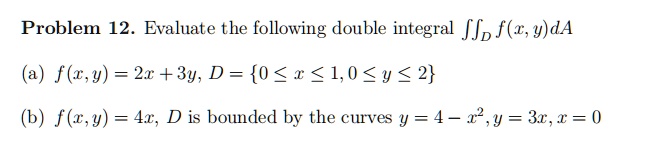
Problem 12. Evaluate the following double integral $\iint_D f(x, y)dA$ (a) $f(x,y) = 2x + 3y$, $D = \{0 \le x \le 1, 0 \le y \le 2\}$ (b) $f(x,y) = 4x$, D is bounded by the curves $y = 4 - x^2$, $y = 3x$, $x = 0$
Read the case study below and answer the questions that follow: Case Background:John Anderson.a 45-year-old male.is admitted to the nephrology unit with a diagnosis of acute glomerulonephritis. He presents with symptoms of hematuria, proteinuria,and hypertension.John has a history of recent streptococcal throat infection and reports facial swelling and decreased urine output.Laboratory results reveal elevated serum creatinine and blood urea nitrogen(BUN) Patient History: Recent streptococcal throat infection approximately two weeks ago. No known history of chronic kidney disease or renal issues. History of hypertension controlled with medication. No significant family history of kidney disease. Presenting Symptoms: 1.Hematuria 2.Proteinuria 3.Hypertension 4.Facial swelling(periorbital edema) 5.Decreased urine output Diagnostic Findings: 1.Elevated serum creatinine and blood urea nitrogen 2.Urinalysis indicating hematuria and proteinuria 3.Antistreptolysin O(ASO)titer indicating recent streptococcal infection 4.Renal biopsy confirming glomerulonephritis Nursing Care Plan