Ace - AI Tutor
Ask Our Educators
Textbooks
My Library
Flashcards
Scribe - AI Notes
Notes & Exams
Download App
chad peinado

chad p.

Divider

Questions asked

BEST MATCH

The data of Exercise 13.25, in which x 5 milk temperature and y 5 milk pH, yield n 5 16 x 5 42.375 S xx 5 7325.75 b 5 2.00730608 a 5 6.843345 s e 5 .0356 a. Obtain a 95% confidence interval for a 1 b(40), the mean milk pH when the milk temperature is 408C. b. Calculate a 99% confidence interval for the mean milk pH when the milk temperature is 358C. c. Would you recommend using the data to calculate a 95% confidence interval for the mean pH when the temperature is 908C? Why or why not?

View Answer
divider
BEST MATCH

Accounts Plastics Metals Lumber Paper Finance Sales to outside parties $ 6,655 $ 2,319 $ 706 $ 417 $ 0 Intersegment sales 143 166 131 143 0 Interest income from outside parties 0 33 20 0 41 Interest income from intersegment loans 0 0 0 0 194 Operating expenses 4,194 1,752 1,056 649 30 Interest expense 75 30 65 24 101 Tangible assets 1,466 3,161 489 736 174 Intangible assets 86 396 0 62 0 Intersegment loans (debt) 0 0 0 0 699 Required: a1. Perform revenue test procedure to determine Chevalier's reportable operating segments. a2. Perform profit or loss test procedure to determine Chevalier's reportable operating segments. a3. Perform asset test procedure to determine Chevalier's reportable operating segments.

View Answer
divider
BEST MATCH

ranitidine and fexofenadine have similar suffixes however they have different mechanisms of actions. what is the difference

View Answer
divider
BEST MATCH

The statement "Sudden infant death syndrome (SIDS) is the most common cause of death between age 1 month and 4 months. Twenty years ago, it resulted in over 5,000 deaths per year" is best described as which component of the evidence-based public health approach?

View Answer
divider
BEST MATCH

20) Given the following data: \[ \begin{array}{ll} \mathrm{N}_{2}(\mathrm{~g})+\mathrm{O}(\mathrm{g}) \rightarrow 2 \mathrm{NO}(\mathrm{g}) & \Delta \mathrm{H}=180.6 \mathrm{~kJ} \\ \mathrm{~N}_{2}(\mathrm{~g})+3 \mathrm{H}_{2}(\mathrm{~g}) \rightarrow 2 \mathrm{NH}_{3}(\mathrm{~g}) & \Delta \mathrm{H}=-91.8 \mathrm{~kJ} \\ 2 \mathrm{H}_{2}(\mathrm{~g})+\mathrm{O}_{2}(\mathrm{~g}) \rightarrow 2 \mathrm{H}_{2} \mathrm{O}(\mathrm{g}) & \Delta \mathrm{H}=-483.7 \mathrm{~kJ} \end{array} \] Calculate the \( \Delta \mathrm{H}^{\circ} \) for the reaction: \( 4 \mathrm{NH}_{3}(\mathrm{~g})+5 \mathrm{O}_{2}(\mathrm{~g}) \rightarrow 4 \mathrm{NO}(\mathrm{g})+6 \mathrm{H}_{2} \mathrm{O}(\mathrm{g}) \) Reverse sec Reaction \( 2 \mathrm{NH}_{3}(\mathrm{~g}) \rightarrow \mathrm{N}_{2}(\mathrm{~g})+3 \mathrm{H}_{0}(\mathrm{~g}) \Delta H_{=}-91.8 \mathrm{~kJ} \) Firet Reaction \[ \begin{array}{l} {\left[\mathrm{N}_{2}(\mathrm{~g})+\mathrm{O}_{2}(\mathrm{~g}) \rightarrow 2 \mathrm{NO}(\mathrm{g})\right] \times 2} \\ 2 \mathrm{~N}_{2}(\mathrm{~g})+2 \mathrm{O}_{2}(\mathrm{~g}) \rightarrow \mathrm{HNO}(\mathrm{g}) \end{array} \] 21) Given the following data: \[ \begin{array}{l} \mathrm{C}_{6} \mathrm{H}_{4}(\mathrm{OH})_{2}(\mathrm{aq}) \rightarrow \mathrm{C}_{6} \mathrm{H}_{4} \mathrm{O}_{2}(\mathrm{aq})+\mathrm{H}_{2}(\mathrm{~g}) \\ \mathrm{H}_{2}(\mathrm{~g})+\mathrm{O}_{2}(\mathrm{~g}) \rightarrow \mathrm{H}_{2} \mathrm{O}_{2}(\mathrm{aq}) \\ \mathrm{H}_{2}(\mathrm{~g})+1 / 2 \mathrm{O}_{2}(\mathrm{~g}) \rightarrow \mathrm{H}_{2} \mathrm{O}(\mathrm{g}) \\ \mathrm{H}_{2} \mathrm{O}(\mathrm{g}) \rightarrow \mathrm{H}_{2} \mathrm{O}(\mathrm{l}) \end{array} \] \[ \Delta H=+177.4 \mathrm{~kJ} \] \[ \Delta H=-191.2 \mathrm{~kJ} \] \[ \Delta H=-241.8 \mathrm{~kJ} \] \[ \Delta H=-43.8 k J \] Calculate the \( \Delta \mathrm{H}^{\circ} \) for the reaction: \[ \begin{array}{l} \mathrm{H}^{\circ} \text { for the reaction: } \\ \mathrm{C}_{6} \mathrm{H}_{4}(\mathrm{OH})_{2}(\mathrm{aq})+\mathrm{H}_{2} \mathrm{O}_{2}(\mathrm{aq}) \rightarrow \mathrm{C}_{6} \mathrm{H}_{4} \mathrm{O}_{2}(\mathrm{aq})+2 \mathrm{H}_{2} \mathrm{O} \text { (1) } \end{array} \]

View Answer
divider
BEST MATCH

3. If the average return for an asset is 5% and the standard deviation is 10%, then 68% of that asset's returns would be between... a. -5% and 15%. b. 0% and 15%. c. -25% and 35%. d. 0% and 35%. e. None of the above.

View Answer
divider
BEST MATCH

A process's X-bar and R-bar charts show it is within control, but which of the following proofs shows that it is NOT the case.

View Answer
divider
BEST MATCH

A graphing calculator is recommended. Find a power series representation for $f$. (Give your power series representation centered at $x = 0$.) $f(x) = \frac{x^2}{x^3 + 1}$ $f(x) = \sum_{n=0}^{\infty} ((-1)^{n-2}x^{2n+2})$ Graph $f$ and several partial sums $s_n(x)$ on the same screen. What happens as $n$ increases? (Enter your answer using interval notation.) As $n$ increases, $s_n(x)$ approximates $f$ better on the interval of convergence, which is $(-1, 1)$.

View Answer
divider
BEST MATCH

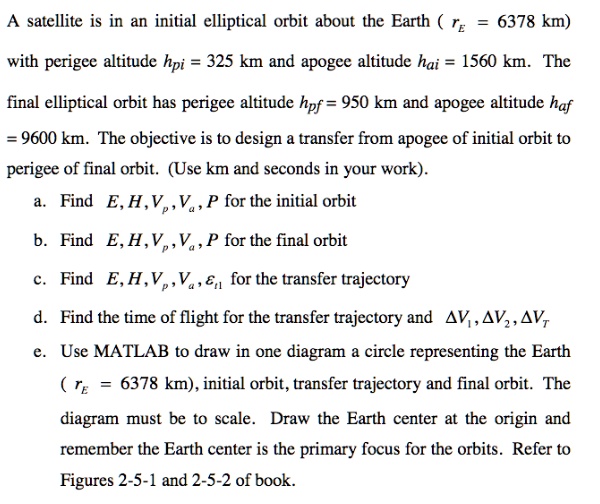
A satellite is in an initial elliptical orbit about the Earth ( rE = 6378 km) with perigee altitude hpi = 325 km and apogee altitude hai = 1560 km. The final elliptical orbit has perigee altitude hpf = 950 km and apogee altitude haf = 9600 km. The objective is to design a transfer from apogee of initial orbit to perigee of final orbit. (Use km and seconds in your work). a. Find E, H, Vp, Va, P for the initial orbit b. Find E, H, Vp, Va, P for the final orbit c. Find E, H, Vp, Va, ?t1 for the transfer trajectory d. Find the time of flight for the transfer trajectory and ?V1, ?V2, ?VT e. Use MATLAB to draw in one diagram a circle representing the Earth ( rE = 6378 km), initial orbit, transfer trajectory and final orbit. The diagram must be to scale. Draw the Earth center at the origin and remember the Earth center is the primary focus for the orbits. Refer to Figures 2-5-1 and 2-5-2 of book.
View Answer
divider
BEST MATCH

QUESTION 2 a) A simply supported beam is subjected to lateral force, $F_1 = 250N$ as shown in Figure. Q2. Determine the maximum deflection of the beam. Given: $L = 3m$, $E = 210GPa$, $I = 2.25 \times 10^{-4} m^4$, and F1 is 1m away from the support A.

View Answer
divider