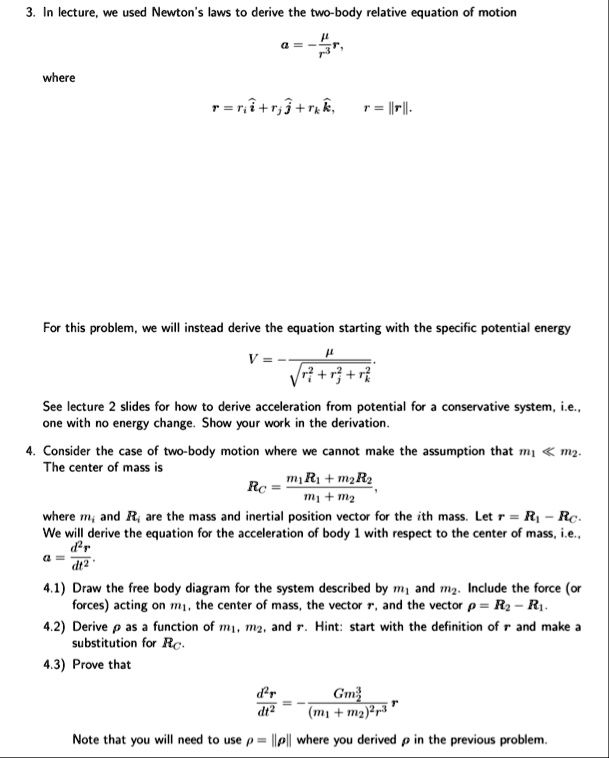
3. In lecture, we used Newton's laws to derive the two-body relative equation of motion
$$a = -\frac{\mu}{r^3}r,$$
where
$$r = r_i\hat{i} + r_j\hat{j} + r_k\hat{k}, \quad r = ||r||.$$
For this problem, we will instead derive the equation starting with the specific potential energy
$$V = -\frac{\mu}{\sqrt{r_i^2 + r_j^2 + r_k^2}}$$
See lecture 2 slides for how to derive acceleration from potential for a conservative system, i.e., one with no energy change. Show your work in the derivation.
4. Consider the case of two-body motion where we cannot make the assumption that $m_1 \ll m_2$. The center of mass is
$$R_C = \frac{m_1R_1 + m_2R_2}{m_1 + m_2},$$
where $m_i$ and $R_i$ are the mass and inertial position vector for the $i$th mass. Let $r = R_1 - R_C$. We will derive the equation for the acceleration of body 1 with respect to the center of mass, i.e.,
$$a = \frac{d^2r}{dt^2}.$$
4.1) Draw the free body diagram for the system described by $m_1$ and $m_2$. Include the force (or forces) acting on $m_1$, the center of mass, the vector $r$, and the vector $\rho = R_2 - R_1$.
4.2) Derive $\rho$ as a function of $m_1$, $m_2$, and $r$. Hint: start with the definition of $r$ and make a substitution for $R_C$.
4.3) Prove that
$$\frac{d^2r}{dt^2} = -\frac{Gm_2^3}{(m_1 + m_2)^2r^3}r$$
Note that you will need to use $\rho = ||\rho||$ where you derived $\rho$ in the previous problem.