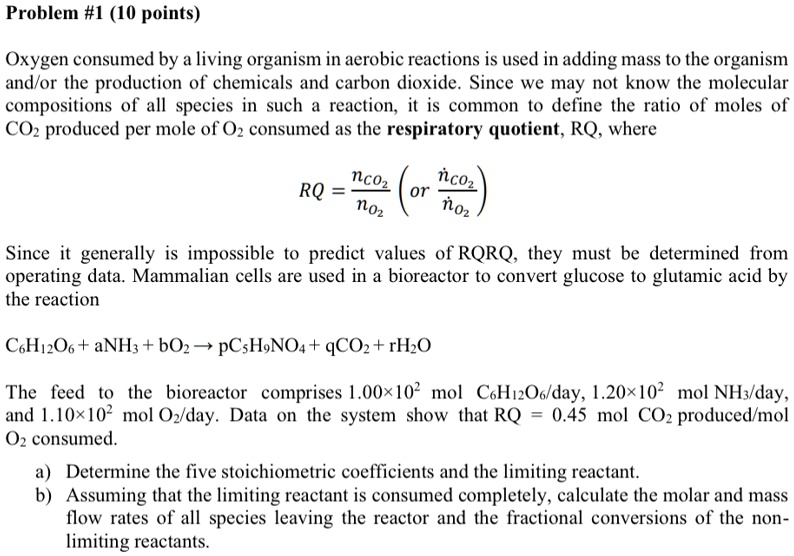
Problem #1 (10 points)
Oxygen consumed by a living organism in aerobic reactions is used in adding mass to the organism
and/or the production of chemicals and carbon dioxide. Since we may not know the molecular
compositions of all species in such a reaction, it is common to define the ratio of moles of
CO2 produced per mole of O2 consumed as the respiratory quotient, RQ, where
$$RQ = \frac{n_{CO_2}}{n_{O_2}} (or \frac{\dot{n}_{CO_2}}{\dot{n}_{O_2}})$$
Since it generally is impossible to predict values of RQRQ, they must be determined from
operating data. Mammalian cells are used in a bioreactor to convert glucose to glutamic acid by
the reaction
$$C_6H_{12}O_6 + aNH_3 + bO_2 \rightarrow pC_5H_9NO_4 + qCO_2 + rH_2O$$
The feed to the bioreactor comprises $$1.00 \times 10^2$$ mol $$C_6H_{12}O_6$$/day, $$1.20 \times 10^2$$ mol $$NH_3$$/day,
and $$1.10 \times 10^2$$ mol $$O_2$$/day. Data on the system show that RQ = 0.45 mol $$CO_2$$ produced/mol
$$O_2$$ consumed.
a) Determine the five stoichiometric coefficients and the limiting reactant.
b) Assuming that the limiting reactant is consumed completely, calculate the molar and mass
flow rates of all species leaving the reactor and the fractional conversions of the non-
limiting reactants.