32. [-/2.5 Points]
DETAILS
MCKTRIG6 4.5.031.
MY NOTES
ASK YOUR TEACHER
PRACTICE ANOTHER
As we discussed earlier in Problem Set 4.2, any object or quantity that is moving with a periodic sinusoidal oscillation is said to exhibit simple
harmonic motion. This motion can be modeled by the trigonometric function
y = A sin (wt)
or
y = A cos (wt)
where A and $\omega$ are constants. The frequency, given by
f = 1/period
represents the number of cycles (or oscillations) that are completed per unit time. The units used to describe frequency are Hertz, where
1 Hz = 1 cycle per second.
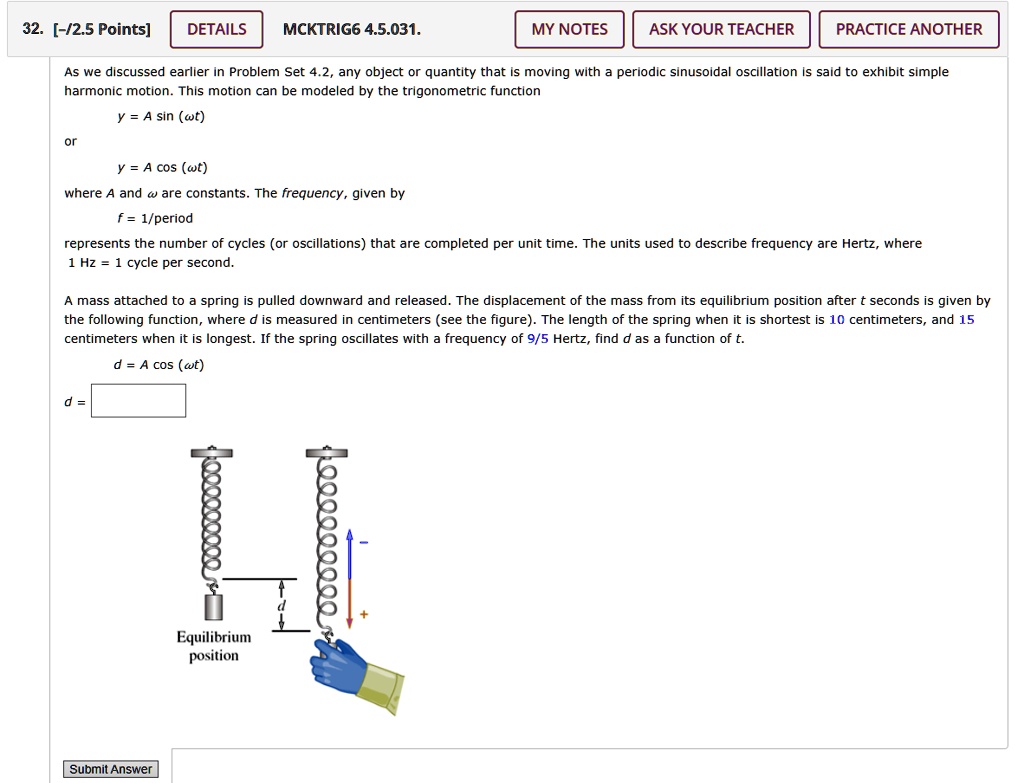
A mass attached to a spring is pulled downward and released. The displacement of the mass from its equilibrium position after t seconds is given by
the following function, where d is measured in centimeters (see the figure). The length of the spring when it is shortest is 10 centimeters, and 15
centimeters when it is longest. If the spring oscillates with a frequency of 9/5 Hertz, find d as a function of t.
d = A cos (wt)
d =