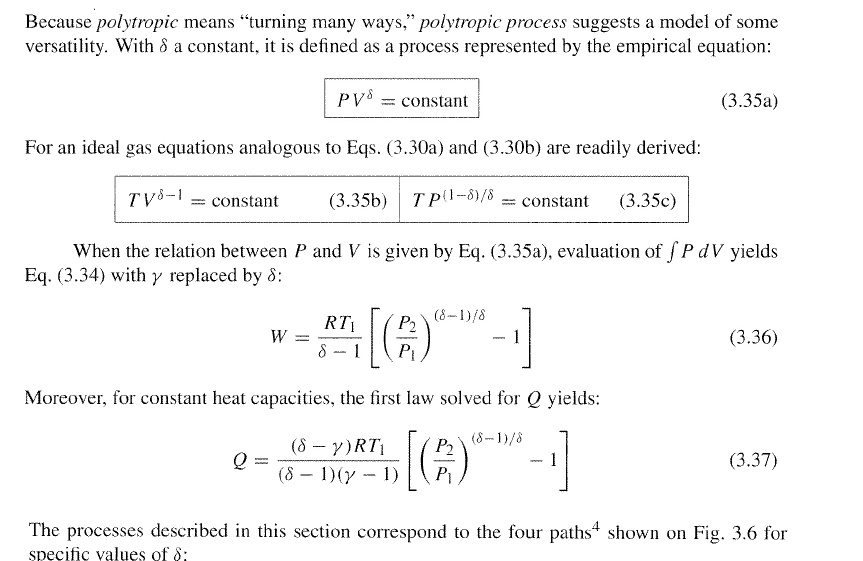
Because polytropic means \"turning many ways,\" polytropic process suggests a model of some
versatility. With $\delta$ a constant, it is defined as a process represented by the empirical equation:
$PV^{\delta} = \text{constant}$
(3.35a)
For an ideal gas equations analogous to Eqs. (3.30a) and (3.30b) are readily derived:
$TV^{\delta - 1} = \text{constant}$
(3.35b) $TP^{(1-\delta)/\delta} = \text{constant}$
(3.35c)
When the relation between $P$ and $V$ is given by Eq. (3.35a), evaluation of $\int P\,dV$ yields
Eq. (3.34) with $\gamma$ replaced by $\delta$:
$W = \frac{RT_1}{\delta - 1} \left[ \left( \frac{P_2}{P_1} \right)^{(\delta - 1)/\delta} - 1 \right]$
(3.36)
Moreover, for constant heat capacities, the first law solved for $Q$ yields:
$Q = \frac{(\delta - \gamma)RT_1}{(\delta - 1)(\gamma - 1)} \left[ \left( \frac{P_2}{P_1} \right)^{(\delta - 1)/\delta} - 1 \right]$
(3.37)
The processes described in this section correspond to the four paths shown on Fig. 3.6 for
specific values of $\delta$: