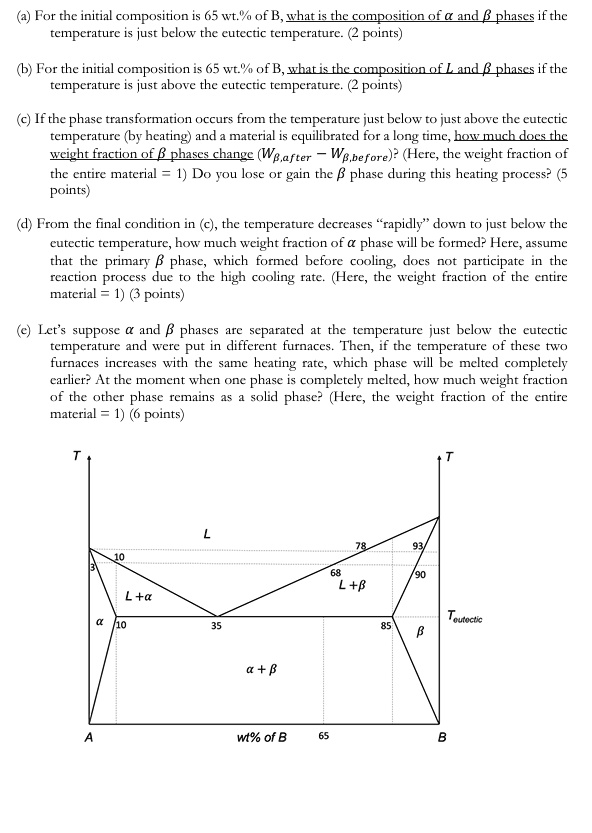
(a) For the initial composition is 65 wt.% of B, what is the composition of $\alpha$ and $\beta$ phases if the temperature is just below the eutectic temperature. (2 points)
(b) For the initial composition is 65 wt.% of B, what is the composition of L and $\beta$ phases if the temperature is just above the eutectic temperature. (2 points)
(c) If the phase transformation occurs from the temperature just below to just above the eutectic temperature (by heating) and a material is equilibrated for a long time, how much does the weight fraction of $\beta$ phases change ($W_{\beta, after} - W_{\beta, before}$)? (Here, the weight fraction of the entire material = 1) Do you lose or gain the $\beta$ phase during this heating process? (5 points)
(d) From the final condition in (c), the temperature decreases "rapidly" down to just below the eutectic temperature, how much weight fraction of $\alpha$ phase will be formed? Here, assume that the primary $\beta$ phase, which formed before cooling, does not participate in the reaction process due to the high cooling rate. (Here, the weight fraction of the entire material = 1) (3 points)
(e) Let's suppose $\alpha$ and $\beta$ phases are separated at the temperature just below the eutectic temperature and were put in different furnaces. Then, if the temperature of these two furnaces increases with the same heating rate, which phase will be melted completely earlier? At the moment when one phase is completely melted, how much weight fraction of the other phase remains as a solid phase? (Here, the weight fraction of the entire material = 1) (6 points)