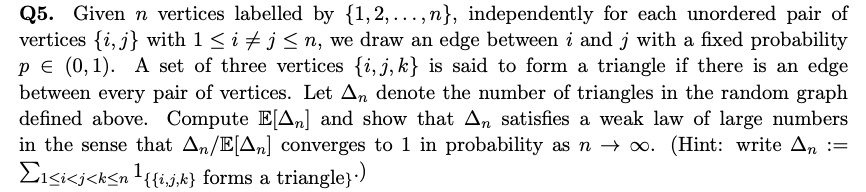
Q5. Given n vertices labelled by \{1, 2, ..., n\}, independently for each unordered pair of vertices \{i, j\} with $1 \le i \ne j \le n$, we draw an edge between i and j with a fixed probability $p \in (0, 1)$. A set of three vertices \{i, j, k\} is said to form a triangle if there is an edge between every pair of vertices. Let $\Delta_n$ denote the number of triangles in the random graph defined above. Compute $E[\Delta_n]$ and show that $\Delta_n$ satisfies a weak law of large numbers in the sense that $\Delta_n / E[\Delta_n]$ converges to 1 in probability as $n \to \infty$. (Hint: write $\Delta_n := \sum_{1 \le i < j < k \le n} \mathbb{1}_{\{\{i, j, k\} \text{forms a triangle}\}}$).