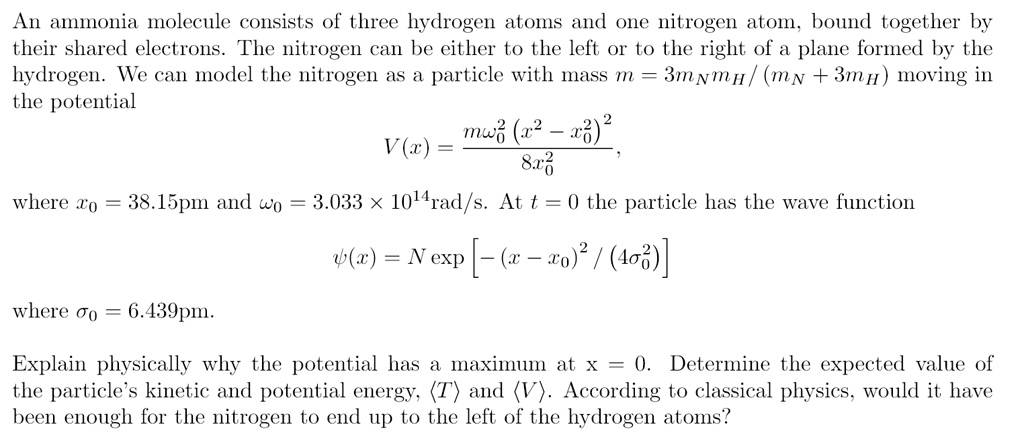
An ammonia molecule consists of three hydrogen atoms and one nitrogen atom, bound together by
their shared electrons. The nitrogen can be either to the left or to the right of a plane formed by the
hydrogen. We can model the nitrogen as a particle with mass $m = 3m_Nm_H/(m_N + 3m_H)$ moving in
the potential
$V(x) = \frac{m\omega_0^2(x^2 - x_0^2)^2}{8x_0^2}$,
where $x_0 = 38.15\text{pm}$ and $\omega_0 = 3.033 \times 10^{14}\text{rad/s}$. At $t = 0$ the particle has the wave function
$\psi(x) = N \exp\left[-(x - x_0)^2 / (4\sigma_0^2)\right]$
where $\sigma_0 = 6.439\text{pm}$.
Explain physically why the potential has a maximum at $x = 0$. Determine the expected value of
the particle's kinetic and potential energy, $\langle T\rangle$ and $\langle V\rangle$. According to classical physics, would it have
been enough for the nitrogen to end up to the left of the hydrogen atoms?