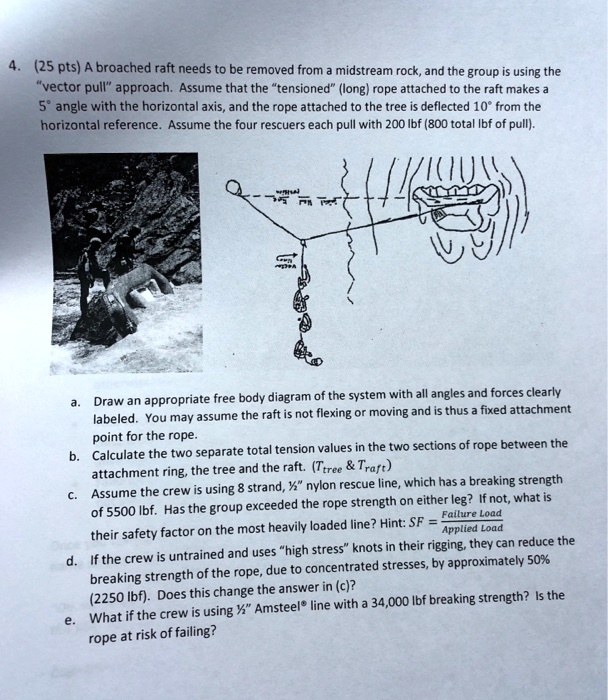
4. (25 pts) A broached raft needs to be removed from a midstream rock, and the group is using the
"vector pull" approach. Assume that the "tensioned" (long) rope attached to the raft makes a
5° angle with the horizontal axis, and the rope attached to the tree is deflected 10° from the
horizontal reference. Assume the four rescuers each pull with 200 lbf (800 total lbf of pull).
a. Draw an appropriate free body diagram of the system with all angles and forces clearly
labeled. You may assume the raft is not flexing or moving and is thus a fixed attachment
point for the rope.
b. Calculate the two separate total tension values in the two sections of rope between the
attachment ring, the tree and the raft. ($T_{tree}$ & $T_{raft}$)
c. Assume the crew is using 8 strand, ½" nylon rescue line, which has a breaking strength
of 5500 lbf. Has the group exceeded the rope strength on either leg? If not, what is
their safety factor on the most heavily loaded line? Hint: $SF = \frac{Failure \ Load}{Applied \ Load}$
d. If the crew is untrained and uses "high stress" knots in their rigging, they can reduce the
breaking strength of the rope, due to concentrated stresses, by approximately 50%
(2250 lbf). Does this change the answer in (c)?
e. What if the crew is using ½" Amsteel® line with a 34,000 lbf breaking strength? Is the
rope at risk of failing?