Ace - AI Tutor
Ask Our Educators
Textbooks
My Library
Flashcards
Scribe - AI Notes
Notes & Exams
Download App
charles williams

charles w.

Divider

Questions asked

BEST MATCH

How would the motor unit play a role in fatigue? A Muscle afferent signals are reduced, signals received by the CNS are decreased, and synaptic inhibition is initiated B Muscle afferent signals are enhanced, signals received by the CNS are multiplied, and synaptic inhibition reduced C Muscle efferent signals are initiated, CNS signals are decreased, and muscle contraction is reduced D Muscle efferent signals are delayed, CNS signals are enhanced, and muscle contraction is initiated

View Answer
divider
BEST MATCH

a What is the organelle indicated by line a ? What is the organelle indicated by line b? What is the organelle indicated by line c? Check Time left 0:19:18 b c

View Answer
divider
BEST MATCH

Suppose you selected two different TVs as best deals for their features and prices. In this situation, the first TV costs $753 and the second costs $396. The first TV is much larger and contains more features and, therefore, is significantly more expensive. In addition to the sticker price, the sales tax is 8.00%.Using the numeric values given above, describe the process, or list the steps, you used to estimate the total cost of the first TV.

View Answer
divider
BEST MATCH

A computer is designed to use 3 stage pipeline snd each stage

View Answer
divider
BEST MATCH

y 10 8 6 f 2 g x -2 2 4 6 8 10 (a) u'(1) = It does exist. u'(1) does not exist because f'(4) does not exist. u'(1) does not exist because g'(1) does not exist. u'(1) does not exist because f'(5) does not exist. u'(1) does not exist because g'(4) does not exist.

View Answer
divider
BEST MATCH

You are bearish on Jawwal and decide to sell short 200 shares at the current market price $60 per share. How much cash or securities must you put in the brokerage account if the broker's initial margin requirement is 60% of the value of the short position? What is the rate of return on the investment if the price falls to $40? How high can the price of the stock go before you get a margin call if the maintenance margin is 30% of the value of the short position?

View Answer
divider
BEST MATCH

Let the joint pdf of X and Y be [2+3+5] f(x, y) = \begin{cases} kx^2y, & \text{if } x^2 \le y \le 1\\ 0 & \text{otherwise} \end{cases} (a) Find the value of k. (b) Hence, compute P(X > Y). (c) Calculate the marginal distributions for X and Y, and check if X and Y are independent.

View Answer
divider
BEST MATCH

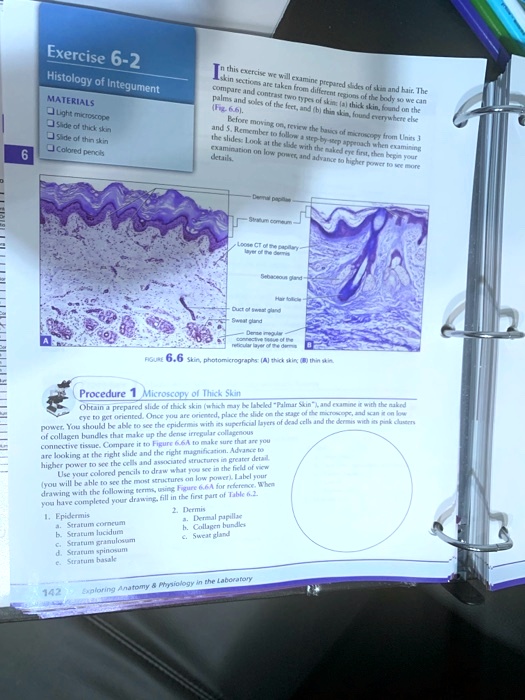
Exercise 6-2 Histology of Integument MATERIALS Light microscope Slide of thick skin Slide of thin skin Colored pencils In this exercise we will examine prepared slides of skin and hair. The skin sections are taken from different regions of the body so we can compare and contrast two types of skin: (a) thick skin, found on the palms and soles of the feet, and (b) thin skin, found everywhere else (Fig. 6.6). Before moving on, review the basics of microscopy from Units 3 and 5. Remember to follow a step-by-step approach when examining the slides. Look at the slide with the naked eye first, then begin your examination on low power, and advance to higher power to see more details. Dermal papillae Stratum corneum Loose CT of the papillary layer of the dermis Sebaceous gland Hair follicle Duct of sweat gland Sweat gland Dense irregular connective tissue of the reticular layer of the dermis FIGURE 6.6 Skin, photomicrographs: (A) thick skin (B) thin skin. Procedure 1 Microscopy of Thick Skin Obtain a prepared slide of thick skin (which may be labeled "Palmar Skin"), and examine it with the naked eye to get oriented. Once you are oriented, place the slide on the stage of the microscope, and scan it on low power. You should be able to see the epidermis with its superficial layers of dead cells and the dermis with its pink clusters of collagen bundles that make up the dense irregular collagenous connective tissue. Compare it to Figure 6.6A to make sure that are you are looking at the right slide and the right magnification. Advance to higher power to see the cells and associated structures in greater detail. Use your colored pencils to draw what you see in the field of view (you will be able to see the most structures on low power). Label your drawing with the following terms, using Figure 6.6A for reference. When you have completed your drawing, fill in the first part of Table 6.2. 1. Epidermis 2. Dermis a. Stratum corneum a. Dermal papillae b. Stratum lucidum b. Collagen bundles c. Stratum granulosum c. Sweat gland d. Stratum spinosum e. Stratum basale 142 Exploring Anatomy & Physiology in the Laboratory
View Answer
divider
BEST MATCH

FIGURE P4-13 Problems 4-26 to 4-27 **4-26 For the linkage in Figure P4-13, find its limit (toggle) positions in terms of the angle of link $O_2A$ referenced to the line of centers $O_2O_4$ when driven from link $O_2A$. Then calculate and plot the angular displacement of links 3 and 4 and the path coordinates of point P between those limits, with respect to the angle of the input crank $O_2A$ over its possible range of motion referenced to the line of centers $O_2O_4$

View Answer
divider
BEST MATCH

Q#1 (CLO2) Marks: 5+5+10=20 Convert given continuous time signal x(t) to x[n] and sketch the following: $x[n] = x(t)[\delta(t + 1/4) + 2\delta(t - 1/2)]$ $h[n] = \begin{cases} a^n, & 0 \le n \le 6\\ 0, & \text{otherwise} \end{cases}$, where a is any real number of your choice. $y[n] = x[n] * h[n]$.

View Answer
divider