Consider the idealized aircraft of weight W in steady level flight as shown in the figure. The fuselage is rigid, able to undergo heave and pitch motions, and the wings include flexible motion in torsion. The wings and tailplane have symmetric sections. Also, the thrust and drag are assumed to be in line and so do not contribute to the pitching moment terms. Determine the full equations of motion for this system and the divergence speed.
Solution begins:
The degrees of freedom for this system are,
q:z, θ_o, θ_t
T=0
U=2(1/2) ∫_0^(sw) GJ(dθ/dy)^2 dy
U=ΔGJ/sW
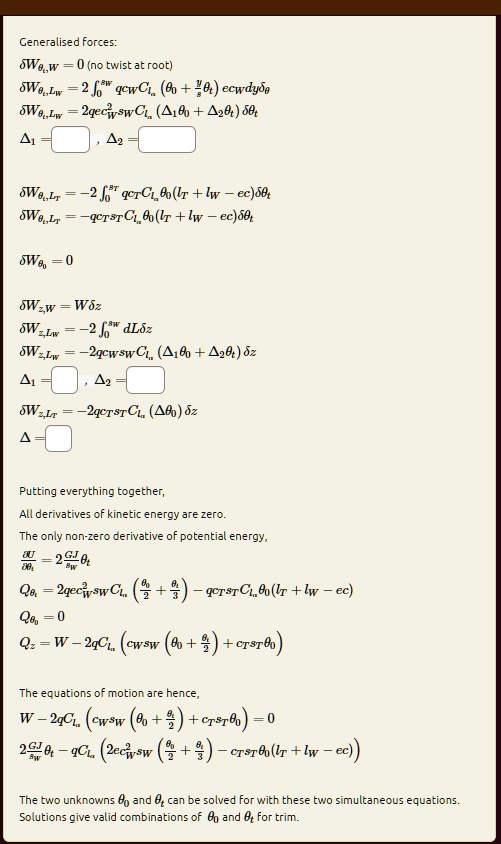
Generalized forces:
We, w = 0 (no twist at root)
WeLw=2JqcwC+ecwdy W, Lw=2qecswCi.(Oo+)&Ot
2
We, L=2 J qcTCAo(lT+lw -ecO -M+Ig1IsIob-=TMS
W=0
8Wz, w=W8z 8WzLw=-2 J65"dL6z 8Wz, Lw=2qcw5wCi.(o+O) z = 2=[ 8W2, Lx=2qcTSTCta(Oo) &z =
Putting everything together
All derivatives of kinetic energy are zero. The only non-zero derivative of potential energy,
Qa=2qecswCt+-qcrsTCiOlr+lw-ec Qa=0 Q=W-2qC(cwswao++cTsTo
The equations of motion are hence, W-2qCia(cwsw(o+)+crsro)=0 2Go-qCa(2ecwsw+-crsTlr+lw-ec
The two unknowns o and, can be solved for with these two simultaneous equations. Solutions give valid combinations of o and t for trim