Points]
ZILLDIFFEQ9 5.1.027.
Points]
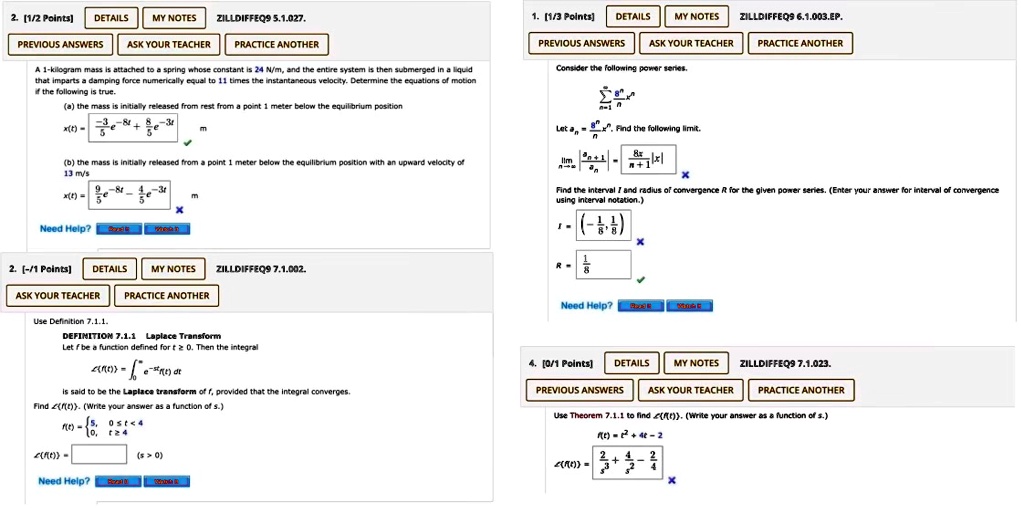
A 1-kilogram mass is attached to a spring whose constant is 24(N)/(m), and the entire system is then submerged in a liquid
that imparts a damping force numerically equal to 11 times the instantaneous velocity. Determine the equations of motion
if the following is true.
(a) the mass is initially released from rest from a point 1 meter below the equilibrium position
(b) the mass is initially released from a point 1 meter below the equilibrium position with an upward velocity of
13(m)/(s)
Need Help?
[-/1 Points]
ZILLDIFFEQ 9 7.1.002.
]
Use Definition 7.1.1.
DEFINITION 7.1.1 Laplace Transform
Let f be a function defined for t>=0. Then the integral
L{f(t)}=int_0^(infty ) e^(-st)f(t)dt
is said to be the Laplace transform of f, provided that the integral converges.
Find /_(f(t)) - (Write your answer as a function of s.)
f(t)={(5,0<=t<4),(0,t>=4):}
l{f(t)}=
(s>0)
Need Help?
2.[1/2 Points]
DETAILS
MY NOTES
ZILLDIFFEQ95.1.027.
1.[1/3 Points]
DETAILS
MY NOTES
ZILLDIFFEQ96.1.003.EP.
PREVIOUS ANSWERS
ASK YOUR TEACHER
PRACTICE ANOTHER
PREVIOUS ANSWERS
ASK YOUR TEACHER
PRACTICE ANOTHER
A 1-kilogram mass is attached to a spring whose constant is 24 N/m, and the entire system is then submerged in a liquid that imparts a damping force numerically equal to 1 times the instantaneous velocity. Determine the equations of motion if the following is true. (a) the mass is initially released from rest from a point 1 meter below the equilibrium position
Consider the followin g power senes
d(t)
Let.. ,Find the following limit
13m/s
+
x(t)
Find the interval I and radius of convergence R for the given power series. (Enter your answer for interval of convergence using interval notation.)
Need Help?
2.[-/1 Points]
DETAILS
MY NOTES
ZILLDIFFEQ97.1.002.
ASK YOUR TEACHER
PRACTICE ANOTHER
Need Help?
Use Definition 7.1.1 DEFINITION 7.1.1 Laplace Transform Let f be a function defined for t 0.Then the integral
4.[0/1 Points]
DETAILS
{ft)}=
et(edr
MY NOTES
ZILLDIFFEQ97.1.023.
is said to be the Laplace tranaform of f, provided that the integral converges Find (/(e)>, (Write your answer as a function of s.) 0st<4 L0, 14
PREVIOUS ANSWERS
ASK YOUR TEACHER
PRACTICE ANOTHER
Use Theorem 7.1.1 to find.Write your an
r as a function of s.)
f=+4=2
(s>0
f
Need Help