Texts: Problem context
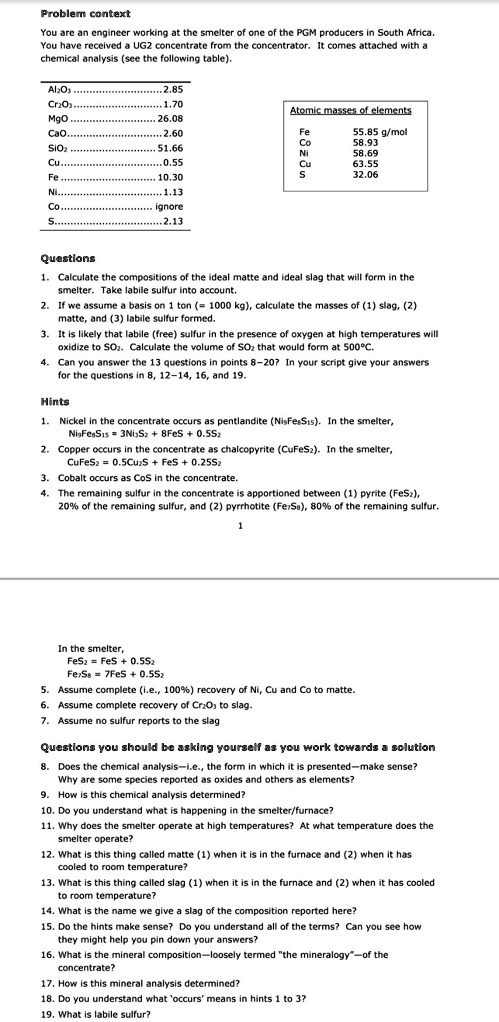
You are an engineer working at the smelter of one of the PGM producers in South Africa. You have received a UG2 concentrate from the concentrator. It comes attached with a chemical analysis (see the following table).
Al2O3 .... Cr2O3 ...... MgO ... CaO..... SiO2 .... Cu...
....2.85 ......1.70 -26.08 ..60 51.66 ...0.55 .10.30 ..1.13 .... ignore ..2.13
Atomic masses of elements: Fe 55.85 g/mol, Ni 58.69 g/mol, S 32.06 g/mol
Ni....
S...
Questions:
1. Calculate the compositions of the ideal matte and ideal slag that will form in the smelter. Take labile sulfur into account.
2. If we assume a basis of 1 ton (= 1000 kg), calculate the masses of (1) slag, (2) matte, and (3) labile sulfur formed.
3. It is likely that labile (free) sulfur in the presence of oxygen at high temperatures will oxidize to SO2. Calculate the volume of SO2 that would form at 500°C.
4. Can you answer the 13 questions in points 8 to 20? In your script, give your answers for the questions in 8, 12-14, 16, and 19.
Hints:
1. Nickel in the concentrate occurs as pentlandite (NiFeS2). In the smelter, NiFeS2 = 3NiS + 8FeS + 0.5S2.
2. Copper occurs in the concentrate as chalcopyrite (CuFeS2). In the smelter, CuFeS2 = 0.5Cu2S + FeS + 0.25S2.
3. Cobalt occurs as CoS in the concentrate.
4. The remaining sulfur in the concentrate is apportioned between (1) pyrite (FeS2), 20% of the remaining sulfur, and (2) pyrrhotite (Fe1-xS, 80% of the remaining sulfur).
5. In the smelter, FeS = FeS + 0.5S2 and Fe1-xS = 7FeS + 0.5S2.
6. Assume complete, i.e., 100% recovery of Ni, Cu, and Co to matte.
7. Assume complete recovery of Cr2O3 to slag.
8. Assume no sulfur reports to the slag.
Questions you should be asking yourself as you work towards a solution:
8. Does the chemical analysis - i.e., the form in which it is presented - make sense? Why are some species reported as oxides and others as elements?
9. How is this chemical analysis determined?
10. Do you understand what is happening in the smelter/furnace?
11. Why does the smelter operate at high temperatures? At what temperature does the smelter operate?
12. What is this thing called matte (1) when it is in the furnace and (2) when it has cooled to room temperature?
13. What is this thing called slag (1) when it is in the furnace and (2) when it has cooled to room temperature?
14. What is the name we give to a slag of the composition reported here?
15. Do the hints make sense? Do you understand all of the terms? Can you see how they might help you pin down your answers?
16. How is this mineral analysis determined?
17. Do you understand what 'occurs' means in hints 1 to 3?
18. What is labile sulfur?