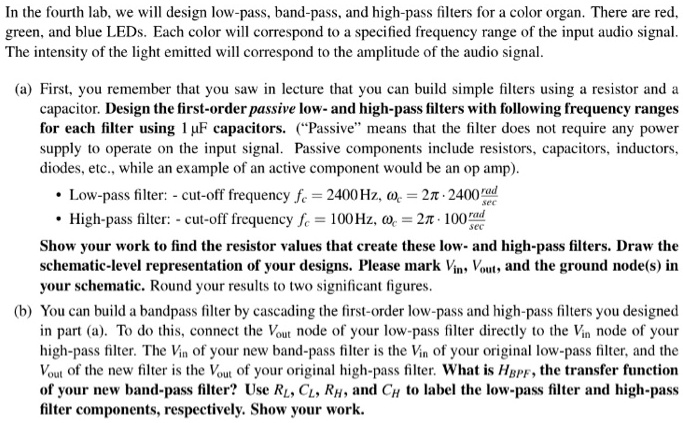
In the fourth lab, we will design low-pass, band-pass, and high-pass filters for a color organ. There are red,
green, and blue LEDs. Each color will correspond to a specified frequency range of the input audio signal.
The intensity of the light emitted will correspond to the amplitude of the audio signal.
(a) First, you remember that you saw in lecture that you can build simple filters using a resistor and a
capacitor. Design the first-order passive low- and high-pass filters with following frequency ranges
for each filter using 1 µF capacitors. ("Passive" means that the filter does not require any power
supply to operate on the input signal. Passive components include resistors, capacitors, inductors,
diodes, etc., while an example of an active component would be an op amp).
$\text{sec}$
• Low-pass filter: - cut-off frequency $f_c$ = 2400 Hz, $\omega_c$ = $2\pi \cdot 2400 \frac{rad}{sec}$
$\text{sec}$
• High-pass filter: cut-off frequency $f_c$ = 100Hz, $\omega_c$ = $2\pi \cdot 100 \frac{rad}{sec}$
Show your work to find the resistor values that create these low- and high-pass filters. Draw the
schematic-level representation of your designs. Please mark $V_{in}$, $V_{out}$, and the ground node(s) in
your schematic. Round your results to two significant figures.
(b) You can build a bandpass filter by cascading the first-order low-pass and high-pass filters you designed
in part (a). To do this, connect the $V_{out}$ node of your low-pass filter directly to the $V_{in}$ node of your
high-pass filter. The $V_{in}$ of your new band-pass filter is the $V_{in}$ of your original low-pass filter, and the
$V_{out}$ of the new filter is the $V_{out}$ of your original high-pass filter. What is $H_{BPF}$, the transfer function
of your new band-pass filter? Use $R_L$, $C_L$, $R_H$, and $C_H$ to label the low-pass filter and high-pass
filter components, respectively. Show your work.