Ace - AI Tutor
Ask Our Educators
Textbooks
My Library
Flashcards
Scribe - AI Notes
Notes & Exams
Download App
chelsea haynes

chelsea h.

Divider

Questions asked

BEST MATCH

Deadweight Loss Scenario (Dollars per day) 1,200 400 B Tax Revenue (Dollars per day) more 0,400 2,000 less Under scenario A, demand is relatively elastic, and the tax results in a deadweight loss and government revenue than under scenario B. This suggests that, all other things being equal, the government should tax industries with a relatively elasticity of demand if it wants to minimize deadweight loss.

View Answer
divider
BEST MATCH

Based on David Hume's theory, which of the following would be considered public goods?

View Answer
divider
BEST MATCH

Which of the following would most likely lead to a decrease in demand?

View Answer
divider
BEST MATCH

What structures does the cliac trunk, Superior mesenteic artery and infereior mesentric artery supply Branch Celiac trunk Structures Supplied Superior mesenteric artery Inferior mesenteric artery

View Answer
divider
BEST MATCH

A concrete operational thinker and a formal operational thinker are given the following logical statements: (1) If you drop a 20-pound bowling ball on your foot, it will tickle. (2) You drop a 20-pound bowling ball on your foot. What reaction would you expect?

View Answer
divider
BEST MATCH

Suppose the demand equation is: Q = 80 - 1.25p. What is the price elasticity of demand if the price is $40 and output is 30 units?

View Answer
divider
BEST MATCH

Passing lanes have been installed to increase passing opportunities at 13 rural two-lane highway sites. An evaluation is to be conducted to determine the overall effect of the installation of these passing lanes on total crashes at the 13 treatment sites. Data for total crash frequencies are available for these sites, including five years of data before and two years of data after installation of the passing lanes. Other available data include the site length (L) and the before- and after-period traffic volumes. To simplify calculations for this sample problem, AADT is assumed to be constant across all years for both the before and after periods. It is also assumed that the roadway characteristics match base conditions and, therefore, all applicable CMFs as well as the calibration factors are equal to 1.0. Calculate the predicted average crash frequency for each site during each year of the before period and submit your data using the following table headings. The table should have 7 columns with rows for each intersection and total. (0.5 points) Site number Predicted before total crash frequency by year (Y1, Y2, Y3, Y4, Y5) Predicted average crash frequency in before period Calculate the overdispersion parameter, weighted adjustment (w), for each site for the before period and the expected average crash frequency for each site, summed over the entire before period. Submit your answers in a table with four columns (Site number, in addition to the three required elements stated by intersection). (0.5 points) Calculate the predicted average crash frequency for each site during each year of the after period and submit your data using the following table headings. The table should have 4 columns with rows for each intersection and total. (0.5 points) Site number Predicted before total crash frequency by year (Y1, Y2) Predicted average crash frequency in before period Calculate the adjustment factor, r, to account for the differences between the before and after periods in duration and the traffic volume at each site and then calculate the expected average crash frequency for each site over the entire period in the absence of the treatment. This table should have three columns (including Site number). (1 point) Calculate an estimate of the safety effectiveness of the treatment at each site in the form of an odds ratio by site. This table should have two columns. (1 point) Calculate the safety effectiveness as a percentage of crash change at each site. This table should have two columns. (1 point) Calculate the overall effectiveness of the treatment for all the sites combined, in the form of an odds ratio. (0.5 points) Calculate the variance terms for each site and total. This table should have two columns. (0.25 points) Calculate the final adjusted odds ratio. (0.5 points) Calculate the overall unbiased safety effectiveness as a percentage change in crash frequency across all sites. (0.5 points) Calculate the variance of OR. (0.25 points) Calculate the standard error of OR. (0.25 points) Calculate the standard error of the safety effectiveness. Assess the statistical significance of the estimated safety effectiveness. Provide a summary of your analysis. The basic input data for the safety effectiveness evaluation, including the yearly observed before- and after-period crash data for the 13 rural two-lane road segments, are presented in the table below. A A Obse Obse Obse Obse Obse Obser Obse Obse Obser S ( A rved rved rved rved rved ved rved rved ved e m befor befor befor befor befor crash after after crash N i) e e e e freque total total frequ U total total total total total ncy in cras cras ency m crash crash crash crash crash the h h in the frequ frequ frequ frequ frequ before frequ frequ after ency ency ency ency ency period ency ency perio Y1 Y2 Y3 Y4 Y5 Y1 Y2 p 8 4 3 1 1 3 12 o 0 0 ONFO 5503 2 0 6 0 o 8 0 o 0 880 5523 5024 0 1 1 3 0 5523 5o24 4 2 1 1 3 2 5 O280 5523 5024 2 4 2 4 2 6 5523 5024 3 2 3 3 5 16 0 1 1 3 5523 5424 N N N 26 22 26 27 [21 122 16 14 30 A 4 4 1 5 2 8858 8 8 3 2 2 2 0 0 2 2 0880 16 1 1 2 6 0 2 2 3 - 2 1 0 4 1 1 2 2 4 2 5 4 3 2 16 0 1 1 r000 6408 6388 5 0 1 1 1 1 6402 6382 1 1 0 2 1 5 1 0 1 0500 6268 6250 7 4 3 3 4 3 17 6 3 9 0987 6268 6250 Crash Data

View Answer
divider
BEST MATCH

3. The diagram below shows the magnetic force acting on the leftmost segment of a loop of wire acted on by the field of a magnet. Current loop is set up as shown so that the magnetic force would tend to rotate the loop about the axis of rotation. Axis of rotation a. What would happen to the direction of the magnetic force if the loop of wire were to undergo one half turn without reversing the direction of the current in the loop? b. Describe the motion of the loop if the current in the loop does not change direction.

View Answer
divider
BEST MATCH

The extra credit is a discussion post (at least 400 words) that engages with the implications of individualistic moral relativism--that is the idea that every individual has their own views of what is good and bad, or that goodness and badness are solely grounded on the individual's preference. For this extra credit: students are to think a society in which "good" and "bad" are left to the interpretation of individuals. That is, think about what a society in which every person acts solely on their own selfish values would look like. There is no "law" or "common moral culture" (like etiquettes, manners, or common courtesy); or at the very least, these elements don't matter since it is up to the individual to value them. In this society, everyone acts "based on what they value". Now, after you have thought about what this society would look like, argue for its desirability or undesirability. That is, provide a detailed argument as to why you'd want to or wouldn't want to live in such a society. After offering insight into its desirability, students must argue whether this society is "bad" or "good" with the same supporting details and reasoning. To get the full points, this extra credit must be turned in before August 2nd, 2021 at 11:59 p.m. and must

View Answer
divider
BEST MATCH

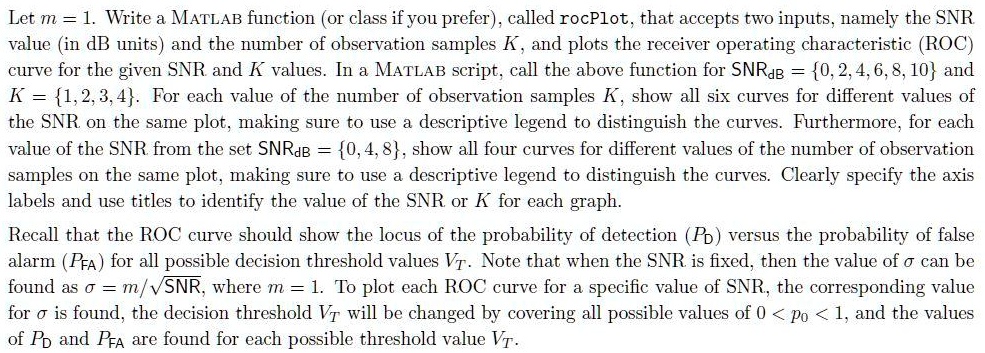
Let m = 1. Write a MATLAB function (or class if you prefer), called rocPlot, that accepts two inputs, namely the SNR value (in dB units) and the number of observation samples K, and plots the receiver operating characteristic (ROC) curve for the given SNR and K values. In a MATLAB script, call the above function for SNRdB = {0, 2, 4, 6, 8, 10} and K = {1,2,3,4}. For each value of the number of observation samples K, show all six curves for different values of the SNR on the same plot, making sure to use a descriptive legend to distinguish the curves. Furthermore, for each value of the SNR from the set SNRdB = {0, 4, 8}, show all four curves for different values of the number of observation samples on the same plot, making sure to use a descriptive legend to distinguish the curves. Clearly specify the axis labels and use titles to identify the value of the SNR or K for each graph. Recall that the ROC curve should show the locus of the probability of detection (PD) versus the probability of false alarm (PFA) for all possible decision threshold values Vr. Note that when the SNR is fixed, then the value of o can be found as $\sigma = m/\sqrt{SNR}$, where m = 1. To plot each ROC curve for a specific value of SNR, the corresponding value for $\sigma$ is found, the decision threshold Vr will be changed by covering all possible values of 0 < po <1, and the values of PD and PFA are found for each possible threshold value V?.
View Answer
divider