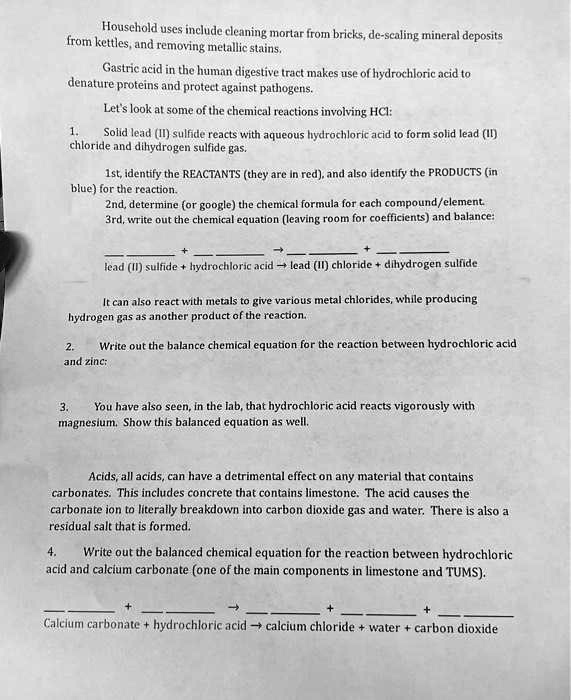
Household uses include cleaning mortar from bricks, de-scaling mineral deposits from kettles, and removing metallic stains.
Gastric acid in the human digestive tract makes use of hydrochloric acid to denature proteins and protect against pathogens.
1. Let's look at some of the chemical reactions involving HCl:
Solid lead (II) sulfide reacts with aqueous hydrochloric acid to form solid lead (II) chloride and dihydrogen sulfide gas.
1st, identify the REACTANTS (they are in red), and also identify the PRODUCTS (in blue) for the reaction.
2nd, determine (or google) the chemical formula for each compound/element.
3rd, write out the chemical equation (leaving room for coefficients) and balance:
$\text{lead (II) sulfide} + \text{hydrochloric acid} \rightarrow \text{lead (II) chloride} + \text{dihydrogen sulfide}$
It can also react with metals to give various metal chlorides, while producing hydrogen gas as another product of the reaction.
2. Write out the balance chemical equation for the reaction between hydrochloric acid and zinc:
3. You have also seen, in the lab, that hydrochloric acid reacts vigorously with magnesium. Show this balanced equation as well.
Acids, all acids, can have a detrimental effect on any material that contains carbonates. This includes concrete that contains limestone. The acid causes the carbonate ion to literally breakdown into carbon dioxide gas and water. There is also a residual salt that is formed.
4. Write out the balanced chemical equation for the reaction between hydrochloric acid and calcium carbonate (one of the main components in limestone and TUMS).
$\text{Calcium carbonate} + \text{hydrochloric acid} \rightarrow \text{calcium chloride} + \text{water} + \text{carbon dioxide}$