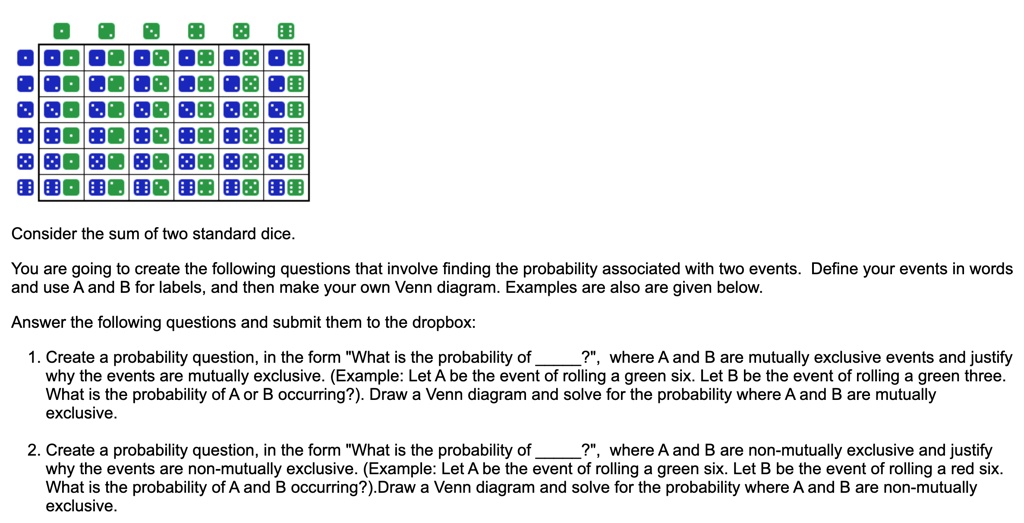
Consider the sum of two standard dice.
You are going to create the following questions that involve finding the probability associated with two events. Define your events in words
and use A and B for labels, and then make your own Venn diagram. Examples are also are given below.
Answer the following questions and submit them to the dropbox:
Create a probability question, in the form "What is the probability of
?", where A and B are mutually exclusive events and justify
why the events are mutually exclusive. (Example: Let A be the event of rolling a green six. Let B be the event of rolling a green three.
What is the probability of A or B occurring?). Draw a Venn diagram and solve for the probability where A and B are mutually
exclusive.
Create a probability question, in the form "What is the probability of ?", where A and B are non-mutually exclusive and justify
why the events are non-mutually exclusive. (Example: Let A be the event of rolling a green six. Let B be the event of rolling a red six.
What is the probability of A and B occurring?).Draw a Venn diagram and solve for the probability where A and B are non-mutually
exclusive.
00 00
.
?
:-:
:
:T.
Consider the sum of two standard dice
You are going to create the following questions that involve finding the probability associated with two events. Define your events in words and use A and B for labels,and then make your own Venn diagram.Examples are also are given below
Answer the following questions and submit them to the dropbox:
1.Create a probability question,in the form "What is the probability of ?", where A and B are mutually exclusive events and justify why the events are mutually exclusive.(Example: Let A be the event of rolling a green six. Let B be the event of rolling a green three What is the probability of A or B occurring?).Draw a Venn diagram and solve for the probability where A and B are mutually exclusive.
2.Create a probability question,in the form "What is the probability of .?", where A and B are non-mutually exclusive and justify why the events are non-mutually exclusive.Example: Let A be the event of rolling a green six. Let B be the event of rolling a red six What is the probability of A and B occurring?).Draw a Venn diagram and solve for the probability where A and B are non-mutually exclusive.