net ionic describes chemical change that occurs, total ionic equation
ionize anything that is strong electrolyte of all species
Part II: Net Ionic
a) Write the molecular, total ionic, and net ionic equations.
b) Predict the expected electrical conductivity after stoichiometric amounts of the reagents are mixed together.
c) Justify your answer by listing the ions causing the electrical conductivity, if any.
$K^+$ $CO_3^{2-}$ $Fe^{2+}$ $Br^-$
1) Potassium carbonate and ferrous bromide.
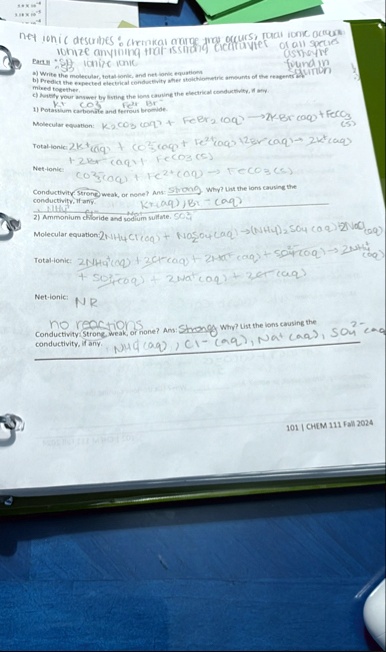
Molecular equation: $K_2CO_3 (aq) + FeBr_2 (aq) \rightarrow 2KBr (aq) + FeCO_3 (s)$
Total-ionic: $2K^+ (aq) + CO_3^{2-} (aq) + Fe^{2+} (aq) + 2Br^- (aq) \rightarrow 2K^+ (aq) + 2Br^- (aq) + FeCO_3 (s)$
Net-ionic: $CO_3^{2-} (aq) + Fe^{2+} (aq) \rightarrow FeCO_3 (s)$
Conductivity: Strong, weak, or none? Ans: Strong. Why? List the ions causing the conductivity, if any.
$K^+ (aq)$, $Br^- (aq)$
2) Ammonium chloride and sodium sulfate. $SO_4^{2-}$
Molecular equation: $2NH_4Cl (aq) + Na_2SO_4 (aq) \rightarrow (NH_4)_2SO_4 (aq) + 2NaCl (aq)$
Total-ionic: $2NH_4^+ (aq) + 2Cl^- (aq) + 2Na^+ (aq) + SO_4^{2-} (aq) \rightarrow 2NH_4^+ (aq) + SO_4^{2-} (aq) + 2Na^+ (aq) + 2Cl^- (aq)$
Net-ionic: NR
no reactions
Conductivity: Strong, weak, or none? Ans: Strong. Why? List the ions causing the conductivity, if any.
$NH_4^+ (aq)$, $Cl^- (aq)$, $Na^+ (aq)$, $SO_4^{2-} (aq)$
101 | CHEM 111 Fall 2024