A) a fixed exchange rate.
B) a flexible exchange rate.
C) a crawling peg.
D) a nominally fixed exchange rate.
E) too high.
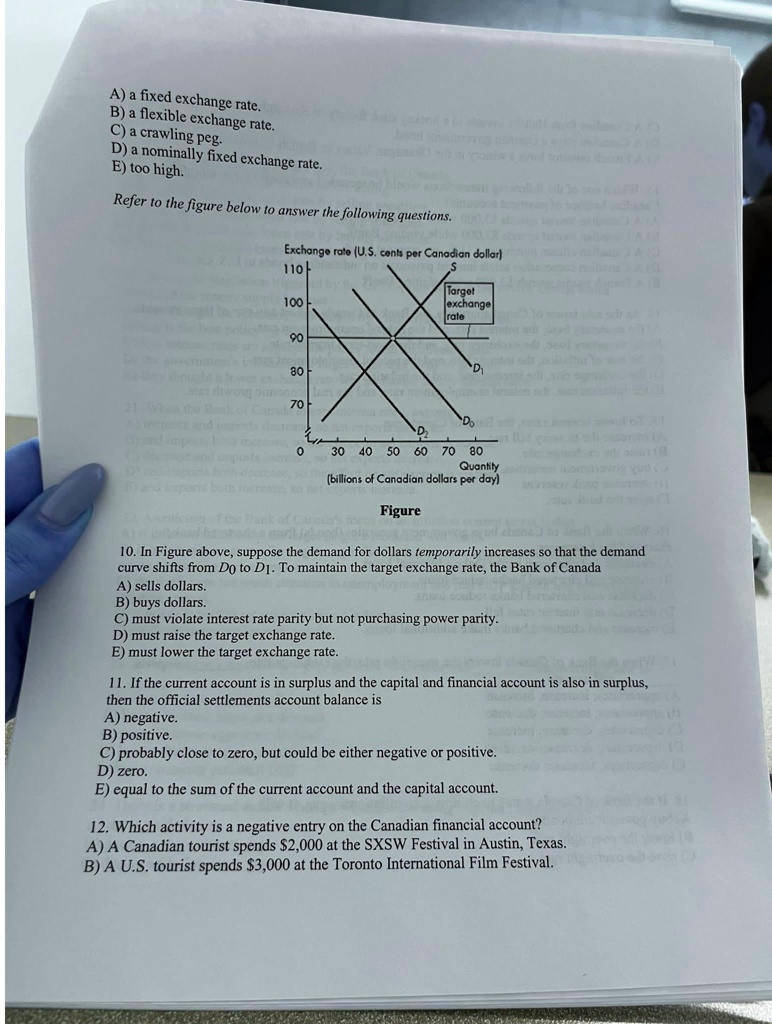
Refer to the figure below to answer the following questions.
Exchange rate (U.S. cents per Canadian dollar)
110
S
100
Target
exchange
rate
90
D1
80
70
Do
D2
0
30 40 50 60 70 80
Quantity
(billions of Canadian dollars per day)
Figure
10. In Figure above, suppose the demand for dollars temporarily increases so that the demand
curve shifts from $D_0$ to $D_1$. To maintain the target exchange rate, the Bank of Canada
A) sells dollars.
B) buys dollars.
C) must violate interest rate parity but not purchasing power parity.
D) must raise the target exchange rate.
E) must lower the target exchange rate.
11. If the current account is in surplus and the capital and financial account is also in surplus,
then the official settlements account balance is
A) negative.
B) positive.
C) probably close to zero, but could be either negative or positive.
D) zero.
E) equal to the sum of the current account and the capital account.
12. Which activity is a negative entry on the Canadian financial account?
A) A Canadian tourist spends $2,000 at the SXSW Festival in Austin, Texas.
B) A U.S. tourist spends $3,000 at the Toronto International Film Festival.