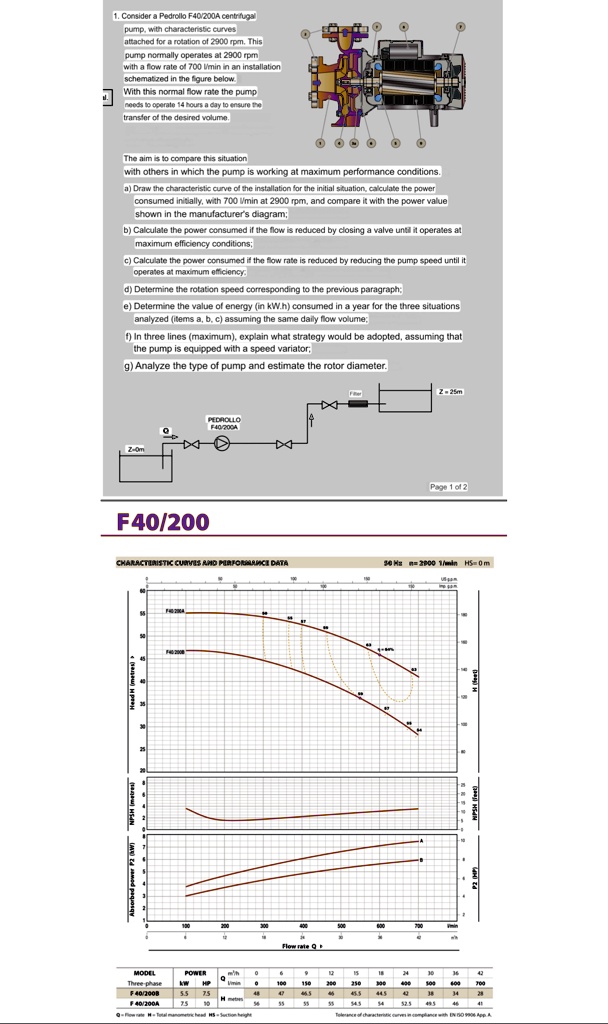
1. Consider a Pedrollo F40/200A centrifugal
pump, with characteristic curves
attached for a rotation of 2900 rpm. This
pump normally operates at 2900 rpm
with a flow rate of 700 l/min in an installation
schematized in the figure below.
With this normal flow rate the pump
needs to operate 14 hours a day to ensure the
transfer of the desired volume.
The aim is to compare this situation
with others in which the pump is working at maximum performance conditions.
a) Draw the characteristic curve of the installation for the initial situation, calculate the power
consumed initially, with 700 l/min at 2900 rpm, and compare it with the power value
shown in the manufacturer's diagram;
b) Calculate the power consumed if the flow is reduced by closing a valve until it operates at
maximum efficiency conditions;
c) Calculate the power consumed if the flow rate is reduced by reducing the pump speed until it
operates at maximum efficiency:
d) Determine the rotation speed corresponding to the previous paragraph:
e) Determine the value of energy (in kW.h) consumed in a year for the three situations
analyzed (items a, b, c) assuming the same daily flow volume;
f) In three lines (maximum), explain what strategy would be adopted, assuming that
the pump is equipped with a speed variator;
g) Analyze the type of pump and estimate the rotor diameter.
F40/200
PEDROLLO
F40/200A
Z-25m
Page 1 of 2
CHARACTERISTIC CURVES AND PERFORMANCE DATA
30 Hz n=2900 1/min HS=0m
Absorbed power P2 (kW) NPSH (metres)
Head H (metres)
MODEL
Three-phase
0/2004