Problem 5.3
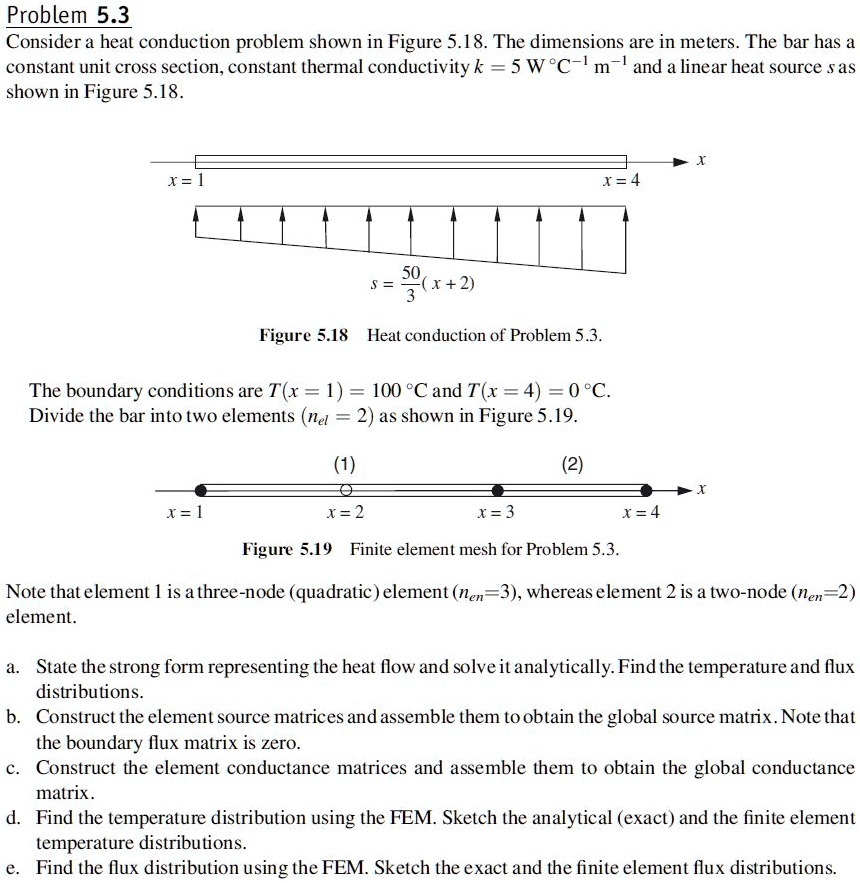
Consider a heat conduction problem shown in Figure 5.18. The dimensions are in meters. The bar has a
constant unit cross section, constant thermal conductivity $k = 5 \text{ W } \degree \text{C}^{-1} \text{m}^{-1}$ and a linear heat source $s$ as
shown in Figure 5.18.
$x = 1$
$s = \frac{50}{3}(x + 2)$
Figure 5.18 Heat conduction of Problem 5.3.
The boundary conditions are $T(x = 1) = 100 \degree \text{C}$ and $T(x = 4) = 0 \degree \text{C}$.
Divide the bar into two elements ($n_{el} = 2$) as shown in Figure 5.19.
$x = 1$
(1)
$x = 2$
$x = 3$
(2)
$x = 4$
Figure 5.19 Finite element mesh for Problem 5.3.
Note that element 1 is a three-node (quadratic) element ($n_{en}=3$), whereas element 2 is a two-node ($n_{en}=2$)
element.
a. State the strong form representing the heat flow and solve it analytically. Find the temperature and flux
distributions.
b. Construct the element source matrices and assemble them to obtain the global source matrix. Note that
the boundary flux matrix is zero.
c. Construct the element conductance matrices and assemble them to obtain the global conductance
matrix.
d. Find the temperature distribution using the FEM. Sketch the analytical (exact) and the finite element
temperature distributions.
e. Find the flux distribution using the FEM. Sketch the exact and the finite element flux distributions.