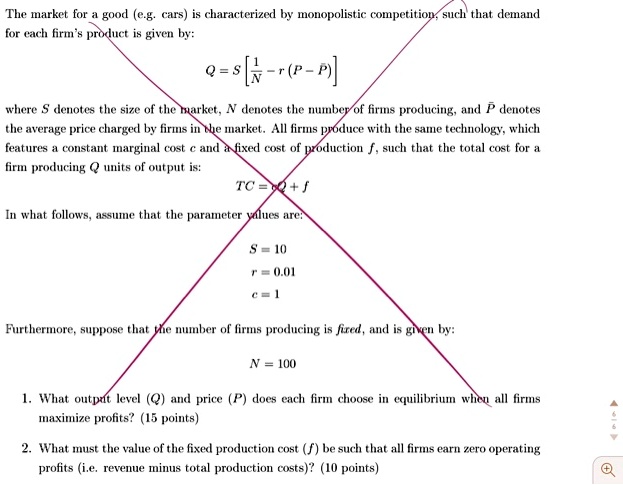
The market for a good (e.g. cars) is characterized by monopolistic competition, such that demand for each firm's product is given by:
$Q = S \left[ \frac{1}{N} - r(P - \bar{P}) \right]$
where $S$ denotes the size of the market, $N$ denotes the number of firms producing, and $\bar{P}$ denotes the average price charged by firms in the market. All firms produce with the same technology, which features a constant marginal cost $c$ and a fixed cost of production $f$, such that the total cost for a firm producing $Q$ units of output is:
$TC = cQ + f$
In what follows, assume that the parameter values are:
$S = 10$
$r = 0.01$
$c = 1$
Furthermore, suppose that the number of firms producing is fixed, and is given by:
$N = 100$
1. What output level ($Q$) and price ($P$) does each firm choose in equilibrium when all firms maximize profits? (15 points)
2. What must the value of the fixed production cost ($f$) be such that all firms earn zero operating profits (i.e. revenue minus total production costs)? (10 points)